About Luscinia svecica (Linnaeus, 1758)
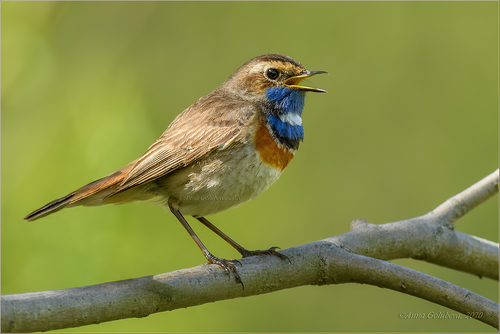
Male Luscinia svecica have the brightest plumage during spring and summer. After the summer moult, fresh new feathers grow with pale tips that cover the throat pattern. These tips wear away in late winter and early spring, revealing the brighter feather bases underneath. Females of all subspecies typically have only a blackish crescent and very little blue on an otherwise cream-colored throat and breast, though older females can develop plumage that is much more similar to that of males. Currently, females are not known to be distinguishable to subspecies by their plumage, with the exception of individuals that have the most male-like plumage. Females of the small subspecies L. s. namnetum and the large subspecies L. s. magna can be identified through careful measurement. Newly fledged juvenile Luscinia svecica are dark brown, with freckles and spots on both their upper and lower bodies, for a few weeks after leaving the nest. They then moult into first-winter plumage, where both sexes resemble adult females and, like adult females, cannot be identified to subspecies. A disjunct population of the subspecies L. s. svecica also breeds at high altitudes in the northern Carpathian Mountains of the Czech Republic. This population is separated altitudinally and ecologically from the low-altitude subspecies L. s. cyanecula found in the same area. These high-altitude birds migrate to India for winter, like other L. s. svecica, instead of migrating to Africa like L. s. cyanecula.