About Luscinia pectoralis (Gould, 1837)
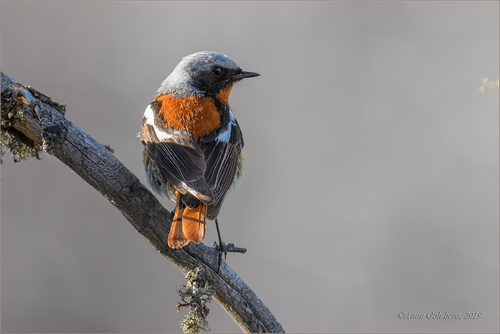
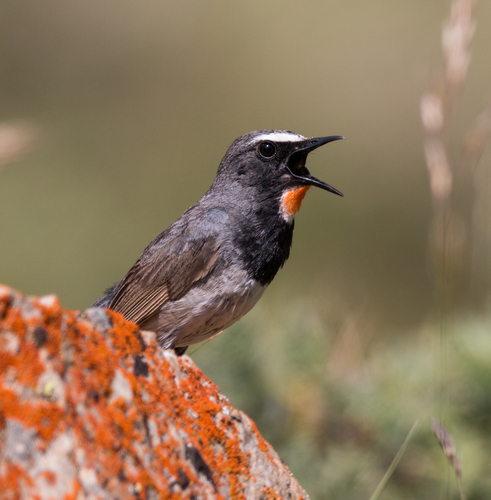
The male Himalayan rubythroat (Luscinia pectoralis, Gould 1837) is slaty brown on the upper body, with a white forehead and white supercilium. Its wings are brownish, and its tail is blackish with white at the base and tips. The sides of its throat and breast are black, while the center of its chin and throat is scarlet. Each black feather on the breast has a narrow grey fringe. Its belly and vent are white. The female is dull brownish-grey on the upper body, with a diffuse supercilium and smoky-colored underparts. The center of her throat is whitish, and eastern populations have a short whitish moustachial stripe. The subspecies C. p. ballioni, found in Afghanistan and the Tien Shan, has paler males than the nominate subspecies native to the western Himalayas. The subspecies C. p. confusa, found in the central and eastern Himalayas of Sikkim and Bhutan, is similar overall but has darker males with a more prominent white forehead. C. p. confusa has a facial pattern that resembles the Siberian rubythroat, with a strong white submoustachial streak, and thin supercilia above the eyes that do not meet at the forehead. Because C. p. confusa is rather distinctive and may be more closely related to the Siberian rubythroat, the taxonomy of this population, as well as the overall classification of this species pair, has been questioned. This species is distributed across Central Asia and the Indian subcontinent, occurring in Afghanistan, Bangladesh, Bhutan, India, Kazakhstan, Myanmar, Nepal, Pakistan, Russia, Tajikistan, Thailand, Turkmenistan, and Uzbekistan. It migrates north to higher altitudes for summer, and moves to lower elevations further south for winter. Subspecies ballioni occupies the western and northern parts of the species' range, while the nominate subspecies occurs along the western and central Himalayas in India. Subspecies C. p. confusa, which may simply represent clinal variation in the darkness of male upper plumage, is found from Sikkim to Assam. Its natural habitat is open woodland and scrub. It may occasionally occur on lower plains in summer, but a historical record of the species further south at Londa near Goa has been confirmed to be a misidentified Siberian rubythroat. One individual was observed by Col Rohit Sharma at Wan Sanctuary, Melghat Tiger Reserve on 29 January 2023 during the first bird survey conducted in the reserve. Adult Himalayan rubythroats are shy, though they will sometimes perch in open areas. They are usually seen alone or in pairs during the breeding season. They feed mainly on small insects, including beetles and ants. During the breeding season, males sing all day from the top of an exposed perch. Their song consists of a series of squeaky notes with a great deal of variation. Females produce an upward-inflected whistle that comes after a short, gruff note. The alarm call is a sharp yapping skyap. In the Tien Shan region, the Himalayan rubythroat lives in juniper elfin thickets at altitudes of 2500 to 2700 m on gently sloping land. Breeding occurs in summer, and nests are built in shrubs near dense tree stands. Nests are placed in the middle of shrubs, and sometimes on the ground within dense tussocks. Most nests are large, loose, ball-shaped with a side entrance, but some are cup-shaped with an open top. Nests are built mainly by the female. Females lay a clutch of 4 to 6 eggs. The eggs are greenish-blue with rusty dots that form a ring near the broader end. Incubation is done mostly by the female, but both parents feed the nestlings after hatching. Eggs hatch after approximately 14 days, and the young fledge and leave the nest around 16 days after hatching. Parents forage close to the nest, and nestlings are mainly fed hairy caterpillars. Himalayan rubythroats have been observed abandoning their nests when a common cuckoo (Cuculus canorus) lays an egg in the nest. Martens and stoats sometimes destroy nests and prey on the young.