About Luscinia calliope (Pallas, 1776)
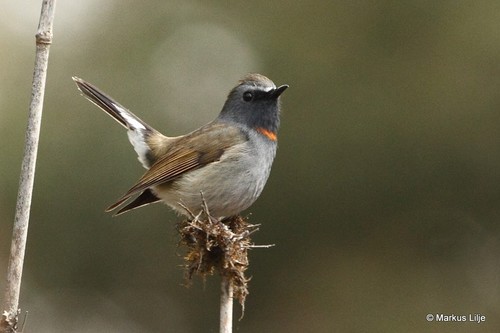
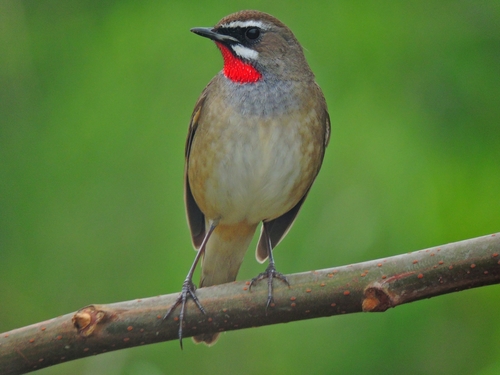
The Siberian rubythroat is a small passerine bird first described by Peter Simon Pallas in 1776. This species was formerly classified as a member of the thrush family Turdidae, but is now more generally considered an Old World flycatcher belonging to the family Muscicapidae. The Siberian rubythroat and similar small European species are often referred to as chats. It is a migratory insectivorous species that breeds in mixed coniferous forests with undergrowth in Siberia, and nests close to the ground. It winters in Thailand, India, Indonesia, and Bangladesh. It is an extremely rare vagrant to Western Europe, with only a very few recorded occurrences as far west as Britain. It is also an extremely rare vagrant to the Aleutian Islands, most notably to Attu Island. This species is slightly larger than the European robin. Its upperparts are plain brown, except for its distinctive black tail with red side patches, and it has a prominent white supercilium. Males have a red throat edged first with a narrow black border, then a broad white border; females do not have this brightly coloured throat and the matching borders. The male's song is similar to a harder, stronger version of the garden warbler's song. The Siberian rubythroat was previously placed in the genus Luscinia. A large molecular phylogenetic study published in 2010 found that Luscinia was not monophyletic. As a result, the genus was split, and several species including the Siberian rubythroat (as the type species) were moved to the reinstated genus Calliope. The name Calliope comes from classical Greek, meaning "beautiful-voiced"; in Greek mythology, Calliope was one of the muses who presided over eloquence and heroic poetry.