About Luronium natans (L.) Raf.
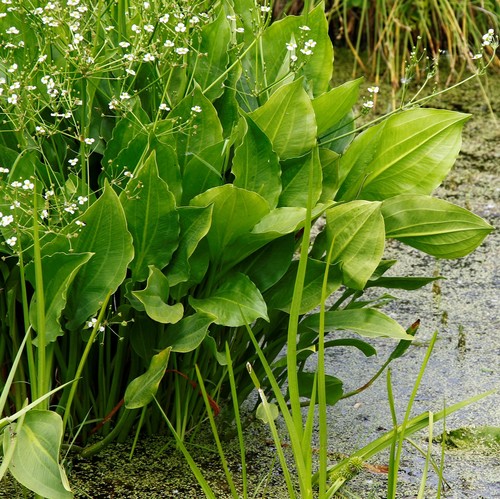
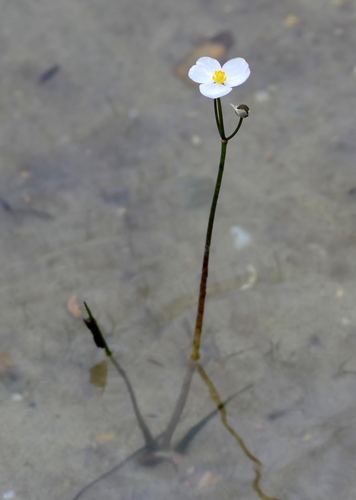
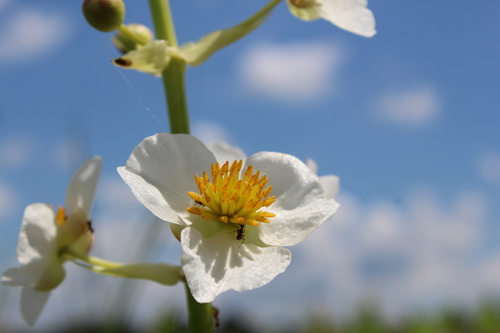
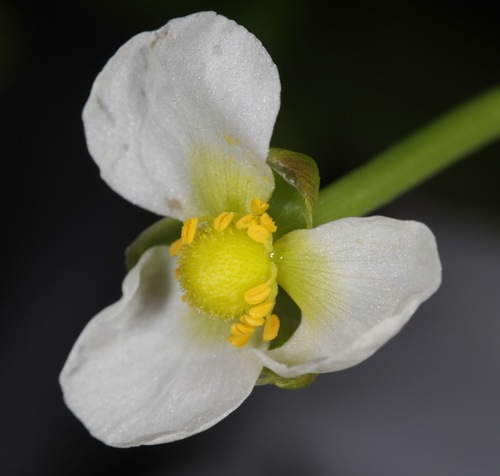
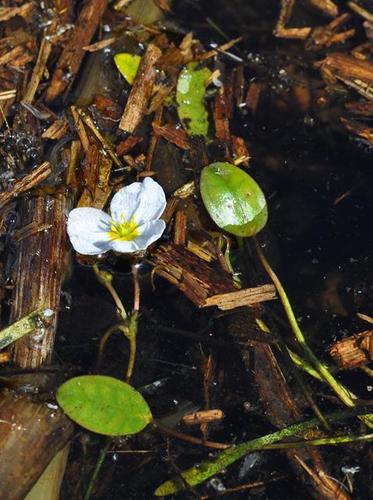
Luronium natans (L.) Raf. has elongated stems that either rise through the water or creep, rooting at their nodes. When present, its submerged leaves are basal and linear. Floating or aerial leaves of this species range from elliptical to ovate in shape. Its flowers are hermaphroditic, borne on long stalks from the leaf axils of floating or aerial leaves. This species has 6 stamens, and 6 to 15 free carpels arranged in an irregular whorl. Each carpel holds a single ovule, with an apical style. The fruitlets are achene-like, marked with many longitudinal ribs, and end in a short apical beak. The chromosome count for this species is 2n = 42. Luronium natans can be hard to identify, as it is highly variable and resembles many other aquatic plants with strap-shaped leaves, including bur-reeds (Sparganium), young water-plantain plants (Alisma), arrowheads (Sagittaria), lesser water-plantain (Baldellia), and mudwort (Limosella aquatica). A stoloniferous growth habit is an important distinguishing feature, and the unusual shape of its floating leaves—rounded at the tip and tapering gradually into the stem—also helps with identification. However, floating leaves are not always present, particularly in populations growing in lakes. When viewed underwater, the submerged leaves show a characteristic ladder pattern with whitish flecks. The full distribution range of floating water-plantain remains uncertain. It is widely distributed across western and central Europe, with confirmed records from Belgium, Denmark, France, Germany, the Netherlands, Poland, the Republic of Ireland, and the United Kingdom. It is also present but rare in northern Spain, the Czech Republic, Norway, and Sweden. Farther east, the distribution is much less certain and requires verification. Records from Bulgaria, Italy, Bosnia-Herzegovina, Croatia, Hungary, Lithuania, Macedonia, Montenegro, Romania, Russia, Serbia, Slovakia, Slovenia, Austria, the Transcarpathian region of Ukraine, and Transylvania are either doubtful or unconfirmed. Ecologically, floating water-plantain grows predominantly in base-poor lakes, ponds, and slow-flowing rivers with low to moderate nutrient levels, though it can sometimes tolerate alkaline systems and/or high nutrient levels. It is able to colonize certain man-made freshwater systems, especially canals.