About Lupinus littoralis Douglas ex Lindl.
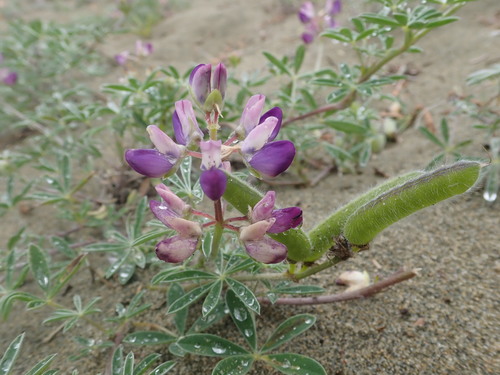
Lupinus littoralis, a species of lupine, is commonly known as seashore lupine. It is native to the western North American coastline, ranging from British Columbia to northern California, where it grows in sandy habitats. This low-growing perennial herb or subshrub forms clumps or mats and reaches no more than 30 centimetres (12 inches) in height. Each palmate leaf is divided into 5 to 9 leaflets that grow up to 3.5 centimetres (1.4 inches) long. All above-ground plant parts are covered in long, shaggy whitish or silvery hairs. Its inflorescence is a raceme of whorled flowers, each around one centimeter long. The flowers are purple, with a white patch on their banner that fades to a pinkish tone over time. The fruit is a hairy legume pod, 3 or 4 centimeters long, that holds up to 12 seeds. Seashore lupine blooms between May and August, and grows at elevations from 0 to 380 meters (0 to 1245 feet). It acts as a host plant for the local butterfly species Glaucopsyche piasus, the Arrowhead Blue. Some Native American tribes consumed the roots of this plant.