About Lupinus caudatus Kellogg
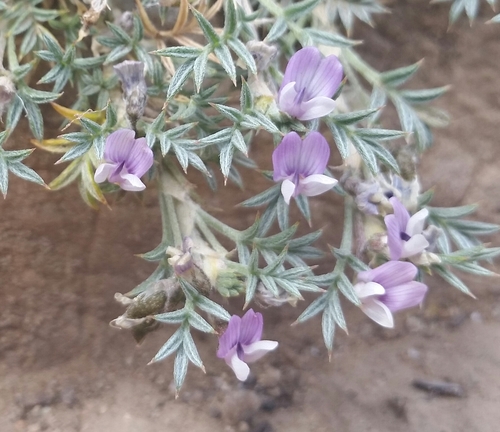
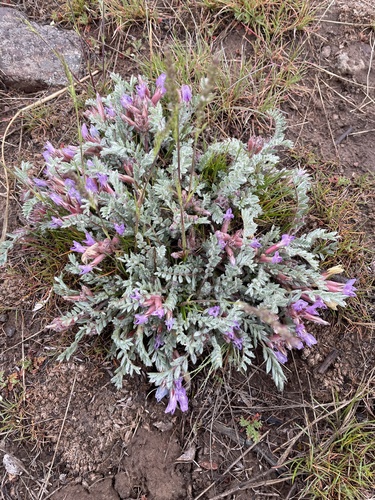
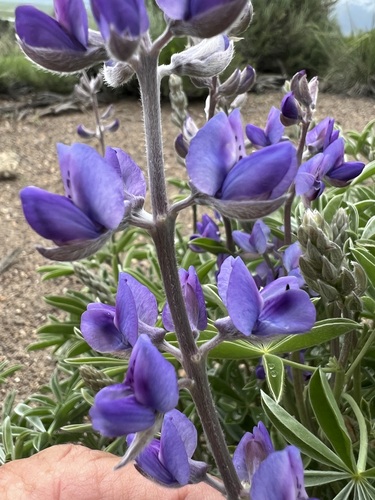
Lupinus caudatus Kellogg is a cool-season herbaceous perennial plant. It grows a thick, deep taproot topped with a woody caudex, a structure located at the base of the stems, at or just below ground level. Flowering stems grow from this caudex, and these stems may be branched or unbranched. Most of the plant's leaves are basal, meaning they grow on individual leaf stems at the base of the plant, and are 6–10 centimeters (2.4–3.9 in) long. Each leaf is palmate compound, meaning it is divided into 5–10 smaller leaflets attached at a central point to form a rounded fan. Leaflets are most often 2–4 cm (0.8–1.6 in) long, but may occasionally reach up to 6 cm (2.4 in). They are 4–8 millimeters wide, linear-oblanceolate (narrow, shaped like a reversed spear point that is wider nearer the end than the base), with a sharp mucronate tip where the leaf rib extends slightly beyond the leaf margin. Leaves are densely covered in fine flat-lying hairs on both upper and lower surfaces, giving them a sericeous appearance like combed silk. Leaflet sides often bend inward until they almost touch, a trait called conduplicate. Flowering stems grow to 20–80 centimeters tall, varying with local conditions. Stems may be branched or unbranched, ending in a 4–10 centimeter long terminal raceme inflorescence that holds many flowers. Flowers are arranged in verticils (groups surrounding the stem) that are about 10–12 millimeters apart, with each flower attached to a 2–4 millimeter long pedicel (small supporting stem). Flowers are 8–12 millimeters long, with a noticeable blunt spur 0.4–1 millimeter long. They are most often blue-purple, though occasional white-flowered individuals occur. The banner petal is pubescent (covered with hairs) on its back and front groove. The lower lip (called the keel) is often at least partially ciliate (fringed with hairs). Blooming starts in May in Utah and Colorado, and starts in June in Wyoming and Montana. The fruit is a pod 25–30 millimeters long and 8–9 millimeters wide, which like the leaves is densely covered in shining silky hairs. Each pod contains 4–6 seeds. The diploid (2n) chromosome count for L. caudatus is either 48 or 96. While Lupinus species often hybridize to produce intermediate individuals, two characteristics distinguish Lupinus caudatus from the closely similar Lupinus argenteus: the combination of a short spur and hairy banner petal reliably identifies L. caudatus. Hybrids between the two species have a shorter spur and usually a smooth banner petal. Lupinus sericeus is also very similar, especially the variety L. sericeus var. utahensis, because it also has a hairy banner petal. However, L. sericeus has more widely spaced flowers, no spur, and lacks long-stemmed basal leaves when flowering. According to the PLANTS database, Lupinus caudatus is found throughout the western United States, from the Rocky Mountains to the Sierra Nevadas and Cascades, with records also from the Texas panhandle, Oklahoma, Nebraska, and South Dakota. The Global Biodiversity Information Facility (GBIF) holds a record of a single undated preserved specimen from Alberta, Canada. GBIF also has numerous specimen records from Mexico (under the synonymized name Lupinus lupinus) collected in the states of Baja California, Baja California Sur, and Durango. Plants of the World Online (POWO) records the species growing in North Dakota, but lacks records of it growing in Washington State, Nebraska, South Dakota, Oklahoma, Texas, or any part of Mexico. The typical habitat of Lupinus caudatus is moderately dry, well-drained soils. It is very common on open hillsides and road cuts, and is occasionally found in moderately moist meadows. It grows alongside sagebrush or in open timber stands, and is especially noted to occur with ponderosa pine (Pinus ponderosa). Additional habitats where it can be found include desert scrub, and mountain or foothill chaparral. It is a fairly common plant across most of its range, and often grows in large local populations. Its elevation ranges from a minimum of 1450 meters in Utah to a maximum of approximately 3150 meters in Colorado. Lupinus caudatus is eaten by elk, mule deer, whitetail deer, antelope, upland game birds, small non-game birds, and small mammals. Observational studies have not found native wild animals to be poisoned by it. On the Columbia Plateau, it is a very important source of forage for pocket gophers in June: one study found more than two-thirds of all forb shoots consumed by pocket gophers were this species, and its leaves were also readily eaten. Because it is one of the more palatable Lupinus species, it is also eaten by sheep, cattle, and horses, sometimes with harmful results for the animals. While it can persist in mature plant communities, Lupinus caudatus populations generally increase after disturbances. Many plants survive wildfires, and will produce seed the following season to recolonize the open landscape. Though the species is good at colonizing open ground and low fertility soils, it does not form a dense root mat, so it is ineffective at preventing erosion in disturbed landscapes. Like many other species in the genus Lupinus, Lupinus caudatus causes a congenital deformity in cattle calves called "crooked calf" by ranchers. This condition is now formally named "lupine induced arthrogryposis", with symptoms including flexure of the front leg joints, twisting of the neck, curvature of the spinal column, and cleft palate. L. caudatus and Lupinus sericeus were the first two species identified as causing crooked calf. The toxin in L. caudatus responsible for this disease is the quinolizidine alkaloid anagyrine; other lupine species contain a different teratogenic compound. L. caudatus can also poison adult cattle when large amounts are consumed, with symptoms including general weakness, muscular trembling, convulsions, and prostration.