About Lunaria annua L.
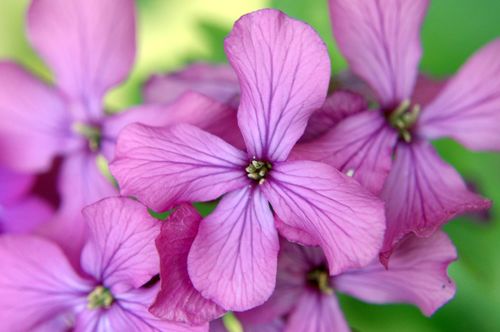
Lunaria annua L. is an annual or biennial plant that grows 90 cm (35 in) tall and 30 cm (12 in) wide. It has large, coarse, pointed oval leaves with prominent serrations. All leaves are hairy: lower leaves have long stalks, while upper leaves are stalkless. In spring and summer, it produces terminal racemes of flowers that can be white, pink, or violet. After flowering, it forms a showy, disc-shaped, translucent structure called a sillicle, which changes from green to light brown as it matures. This structure is not a true botanical seedpod, and it is sometimes commonly referred to as moonpennies. When a sillicle is ripe and dry, a valve on each side easily detaches. The seeds then fall away from the central membrane, which has a silvery sheen and measures 3–8 cm (1–3 in) in diameter. Depending on weather conditions, this membrane can remain on the plant through the winter. These sillicles are widely used in dry floral arrangements. Lunaria annua is native to southern Europe, ranging from Spain to Romania. It has been introduced to many other temperate regions around the world. This plant is easy to grow from seed and often naturalizes on its own. It is typically cultivated as a biennial: sown in one year to bloom the next. It grows well in shady or dappled light, and is a good fit for wildflower gardens. Its flowers and dried sillicles are commonly used in floral arrangements. Many varieties and cultivars of Lunaria annua are available. The white-flowered L. annua var. albiflora and the variegated white cultivar L. annua var. albiflora 'Alba Variegata' have both earned the Royal Horticultural Society's Award of Garden Merit.