About Luma apiculata (DC.) Burret
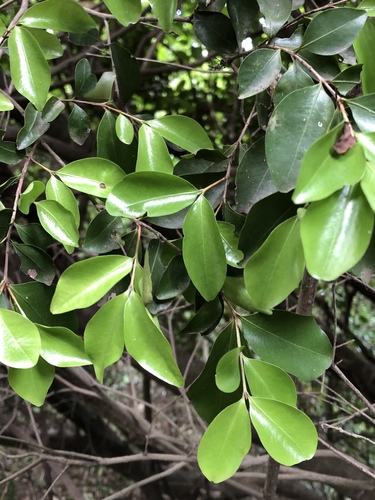
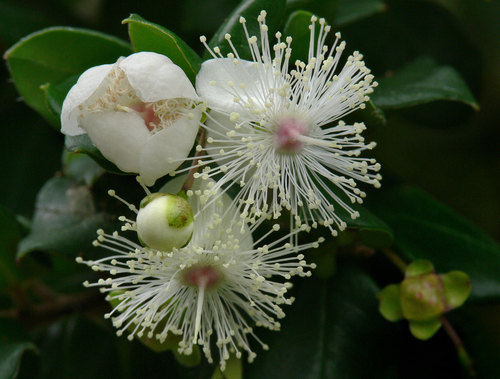
Luma apiculata, commonly known as Chilean myrtle, is a slow-growing species that typically forms a small tree around 10 to 15 m tall, rarely reaching 20 m. It has a twisted, contorted trunk with smooth grey to bright orange-brown bark that peels as the tree grows, creating a two-tone appearance of rich cinnamon colour contrasted with cream. It is evergreen, bearing small, fragrant, oval leaves 2.0 to 2.5 cm long and 1.5 cm broad, and produces profuse white flowers in early to midsummer. Its fruit is an edible black or blue berry 1.0 cm in diameter, which ripens in early autumn. In its native habitat, Chilean myrtle grows along watercourses in the Valdivian temperate forests of Chile. In Argentina, it grows from Neuquén south to the Chubut River. Its main native forest stands occur on the Quetrihué Peninsula (Mapuche for 'myrtles') in Los Arrayanes National Park, and on Isla Victoria in Nahuel Huapi Lake in Nahuel Huapí National Park, Argentina. Smaller populations can also be found along the Arrayanes River in Los Alerces National Park. Trees in these protected areas can be up to 650 years old. The notable Chilean myrtle forest in Argentina's Los Arrayanes National Park covers 20 ha of the Quetrihué Peninsula, where the cinnamon-coloured myrtles leave almost no space for other trees. In cultivation and uses, the fruit of Luma apiculata is appreciated in Chile and Argentina, and its flowers are important for honey production. The Mapuche people use this species for medicinal purposes. It is also grown as bonsai and cultivated in gardens for the attractive contrast of its glossy foliage and slender red stems. It has become naturalised in parts of Ireland and western Great Britain, has been planted in Spain, and is suspected to be naturalising in New Zealand and the Pacific Northwest of the United States. This plant has received the Royal Horticultural Society's Award of Garden Merit.