About Ludwigia sedioides (Bonpl.) H.Hara
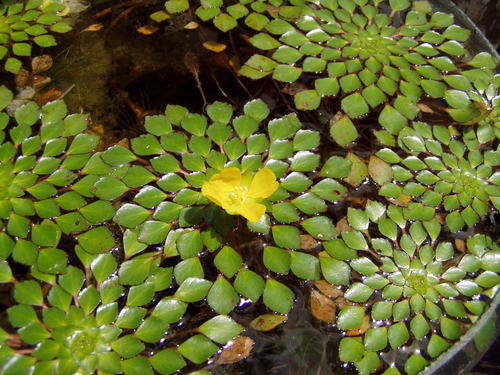
Ludwigia sedioides, commonly known as mosaic plant, is an aquatic herbaceous shrub. It grows in standing pools of water, where its leaves float on the surface, or in very swampy wet soils. Its stems are reddish and brittle. It produces diamond-shaped leaves with toothed margins that radiate outward to form mosaic-like rosettes. When grown under bright light or full sunlight, the edges of central and older leaves turn bright red. The leaf rosettes are fully extended with gaps between leaves during the day, and contract at night so the leaves overlap each other.
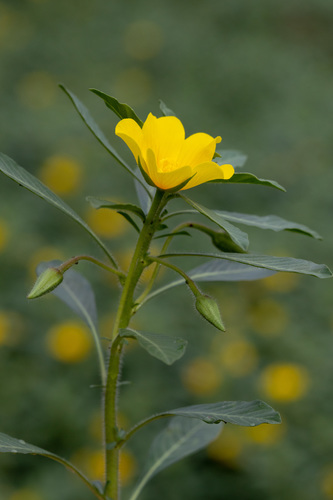
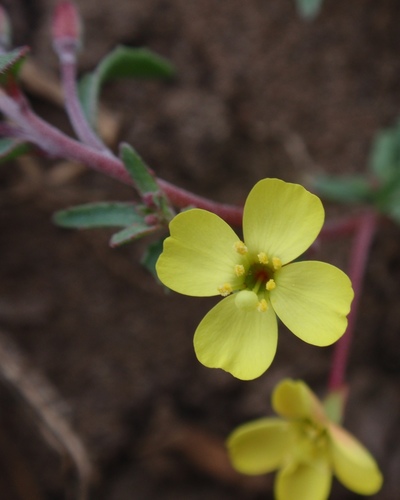
For its reproductive characteristics: bright yellow, cup-shaped, solitary flowers grow from leaf axils between June and August in the species' native habitats. The flowers measure 50 mm (2 in) across. The fruits are explosive capsules.
This plant is native to subtropical regions of America, specifically Central and South America, with its primary distribution in Venezuela, Panama, Colombia, and Brazil. It has been identified as a potentially invasive plant in Sri Lanka, due to its rapid growth, efficient reproduction, and aggressive growth habit. It may pose a future threat to Sri Lanka's biodiversity.
Ludwigia sedioides is used as an ornamental plant. Outside its natural habitat, it is cultivated for personal artificial ponds and aquariums. Cultivating it in aquariums is somewhat complicated because it requires specific amounts of sunlight and nutrients. It is suited for ponds or containers with water depths between 30 and 60 cm (12 to 24 in), and it needs to be rooted in the substrate below the water surface.