About Loxostege sticticalis Linnaeus, 1761
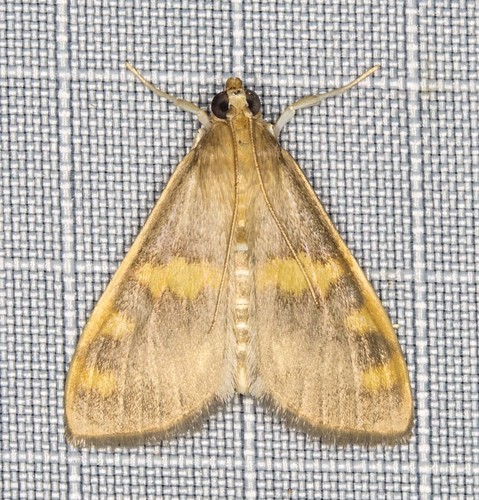
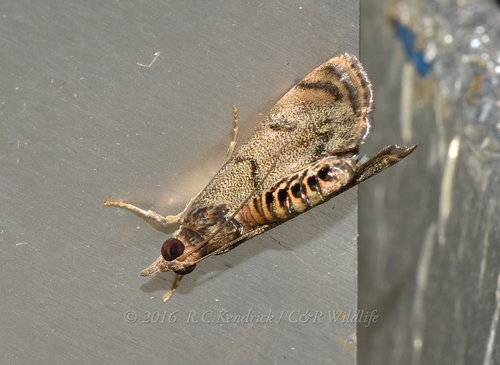
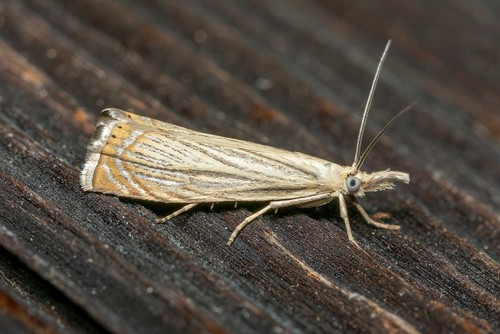
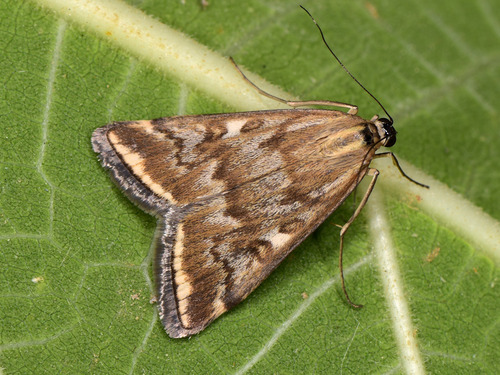
Loxostege sticticalis is a species of moth in the family Crambidae. It was first described by Carl Linnaeus in 1761, and occurs in the Palearctic and Nearctic realms. This moth has a wingspan of 24–29 millimetres, or 0.94–1.14 inches. The pattern and colour of its wings vary greatly. The base ground colour of the wings ranges from light brown to darker brown to reddish brown. The darker wing markings are also highly variable. It may have an indistinct inner transverse line, ring, kidney and cone blemishes, as well as a usually very distinct, jagged outer transverse line; occasionally, additional spots appear in the wing's midfield. This entire pattern can also be almost completely absent, when forewings are almost uniformly grey-brown, with only faint traces of individual blemishes sometimes remaining. Grey fringes are typical: a dark narrow fringe line towards the wing base, followed by a narrow yellow to whitish transverse band. This band is somewhat thickened in the front half, towards the costal edge, and thickened near the middle. Often, a bright spot forms near the edge of the seam, in the area where the outer transverse line meets the costal edge. Most specimens also have a very characteristic rectangular, concave light spot between the ring and kidney blemish; this spot is usually present even in specimens with very little overall markings, though it may be missing in extreme cases of almost uniformly grey-brown individuals. The uppersides of the hindwings are grey, with a dark fringing line that is itself lined with a narrow light line towards the wing base. A more or less complete, relatively wide outer transverse line is also often present, and its inner edge may be lightened. The undersides of both the forewings and hindwings are yellowish, with a broad brown border area and usually two additional broad brown to dark brown transverse bands. This moth flies from May to September, with the exact timing varying by location. Its larvae feed on a variety of herbaceous plants, including mugwort (Artemisia vulgaris), beet, Chenopodium album, and Artemisia campestris. It can become a pest of sugar beet and tobacco.