About Loxioides bailleui Oustalet, 1877
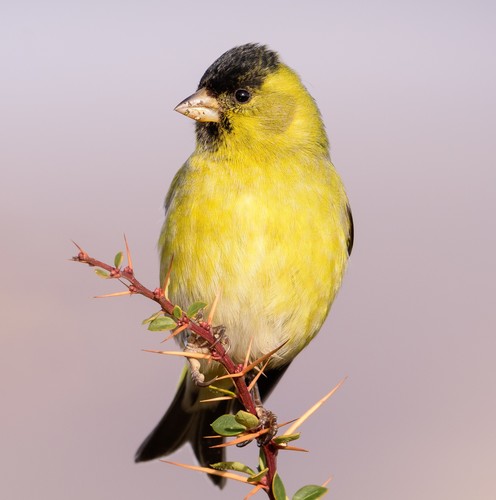
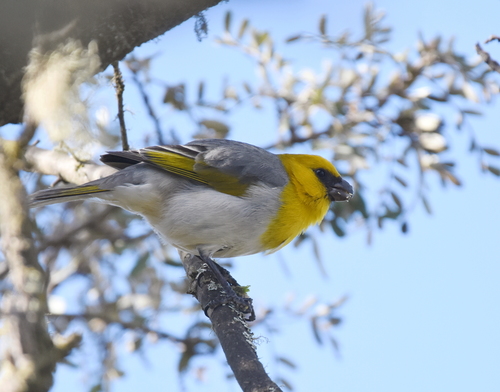
The palila (Loxioides bailleui Oustalet, 1877) has a yellow head and breast, with white to light gray plumage on its underside, medium gray plumage on its back, and olive-green wings and tail. It also has a heavy dark bill with swollen sides, a brown iris, and dark feet with yellowish soles. The palila is one of the largest living Hawaiian honeycreepers, measuring 15–19 cm (6–7.5 inches). It is the heaviest Hawaiian honeycreeper, with an average body mass of 38.1 g (1.34 oz) for males and 37.6 g (1.33 oz) for females. There is some sexual dimorphism: males generally have brighter overall coloration and clear-cut black lores, while females are marginally smaller, and the lore area contrasts less with their dirty-yellow heads. The palila's song is inconspicuous, made up of whistling, warbling, and trilling notes. Its call is characteristic, however: a clear, bell-like whistle transcribed as chee-clee-o or te-cleet. Birds call loudly with this vocalization to advertise food during the morning and evening, and according to native accounts, it is given most frequently during the day as rain approaches. Currently, palila are found only on the upper slopes of Mauna Kea on the island of Hawaiʻi, at elevations of 2,000 to 2,900 m (6,500 to 9,500 ft) above mean sea level. Population density increases in areas where māmane (Sophora chrysophylla) grows more abundantly, and the birds do not tend to venture far from māmane stands. This means the species is, and likely always has been, confined to the area above the moist forest belt located around 910–1,370 m (3,000–4,500 ft) elevation. The fossil record shows that before human arrival, palila also occurred on Kauaʻi and Oʻahu, and likely also occurred on Maui and neighboring islands, but it has not been recorded outside the island of Hawaiʻi since European arrival. Palila now occupy less than 10 percent of their historical range; they were found at elevations as low as 1,200 m (4,000 ft) as recently as the 19th century. Loxioides bailleui was abundant across Hawaiʻi until the beginning of the 20th century, when it lived on the upper slopes of Mauna Kea, the northwest slopes of Mauna Loa, and the eastern slopes of Hualālai. By 1944, scientists already considered the species almost extinct. On March 11, 1967, the palila was listed as an endangered species under the Endangered Species Act. In 1975, the total population was estimated at just 1,614 individuals. In 1978, the 9th Circuit Court of Appeals ruled that feral sheep and goats had to be removed from the species' critical habitat. Annual counts between 1980 and 1996 produced variable population estimates ranging from 1,584 to 5,685 mature birds, with no consistent population trends during this period. In 1997, 72% of the total population was found on the west slope of Mauna Kea. The entire estimated population of 4,396 birds occupied an estimated 78 square kilometres (19,000 acres). From 1998 to 2024, the population declined by more than 90%, an average decline of 205 birds per year, with 100% statistical support for this overall downward trend. As of 2024, the estimated total population is between 412 and 970 birds, with a point estimate of 666 individuals. In 2025, the U.S. Fish and Wildlife Service completed a five-year status review for the palila, confirming its continued classification as endangered. The palila prefers dry forest habitat dominated by māmane or a mix of māmane and naio (Myoporum sandwicense), which also includes patches of grassland, pūkiawe (Styphelia tameiameiae) shrubland on lava fields, and other types of native understory vegetation. When available, the palila's diet is almost exclusively made up of immature māmane seeds. These seeds contain large amounts of foul-tasting phenolic compounds in the seed coat and a lethal amount of quinolizidine alkaloids in the embryo. Through an unknown mechanism, adult palila can tolerate a dose of these toxins that would kill other small animals in just minutes. Toxin levels vary between māmane trees, and palila are observed avoiding certain trees. It is possible these avoided trees have the highest toxin concentrations, but it is unknown how the birds recognize this. The bitter taste of the seed coats likely does not affect the birds, but the seed coats are low in nutrition so they are discarded. Palila bills are adapted to open the pods of Fabales like māmane. The birds hold the pod with one foot and pry it open with their bill to expose the seeds. They then tear away the visible portion of the seed coat and extract the embryo, leaving the remaining seed coat in the pod. Any seeds that fall out of the pod intact during opening are picked up and positioned lengthwise in the bill. The edge of the bill neatly cuts open the seed coat, and the bird pushes the embryo out with its tongue, leaving the intact seed coat to fall away. Palila also eat naio berries and other fruit (including the introduced Cape gooseberry), plus māmane flowers, buds, and young leaves. They additionally feed on caterpillars, particularly those of Cydia species (māmane codling moths), and more rarely on caterpillars of Uresiphita polygonalis virescens (māmane snout moth). These caterpillars, along with other insects, and the highly nutritious māmane seeds, are the palila's main sources of protein. Nestlings, which are apparently not yet able to tolerate the toxin content of māmane seeds, are fed mostly Cydia caterpillars. These caterpillars break down or discard the māmane toxins they ingest from their food, so the caterpillars themselves are non-toxic. They do retain high amounts of phenolic compounds they sequester from their food and are likely bad-tasting. Palila do not seem to object to this bad taste or are physically unable to perceive it, as they go to great lengths to obtain this food during the breeding season. The abundance of māmane seeds impacts palila reproduction rates and adult survival. Palila begin feeding on māmane seeds at higher elevations, then gradually move downslope as the season progresses. During droughts, when māmane seeds are scarce, most birds do not attempt to breed. Palila normally breed from February to September. The female builds a loose, cup-shaped nest around 10 cm (4 inches) in diameter high in a māmane or naio tree. She uses grasses, stems, roots, lichen, and bark from māmane trees as building materials, and lines the inside of the nest with lichen and small leaves. Palila usually lay a clutch of two eggs. Both parents feed their young by regurgitation. Juveniles stay in the nest for up to 31 days before fledging.