About Loxia sinesciuris Benkman, 2009
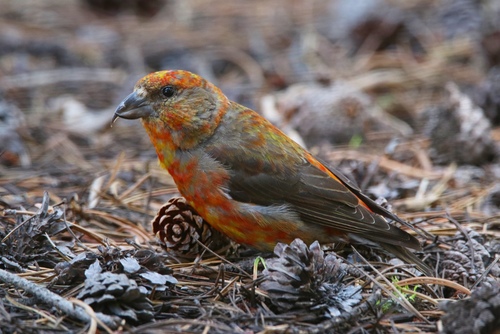
The Cassia crossbill (Loxia sinesciuris Benkman, 2009) shares many physical traits with red crossbills and all of their different call types. Adult males have brick red plumage on their crown, breast, and belly, and brown flight feathers. Adult females, by contrast, have overall dull green or olive-yellow plumage, also with brown flight feathers. Its most notable characteristic is the crisscrossed, crossed bill that it uses to get seeds out of pine cones. Compared to all red crossbill call types, the Cassia crossbill has a deeper, thicker bill that lets it crack open the harder pine cones found in its habitat. Its body mass ranges from 29.2 to 43.9 grams, its wing length ranges from 85.0 to 100.0 millimeters, and its bill depth ranges from 8.90 to 10.56 millimeters.
The Cassia crossbill lives year-round exclusively in the forests of the South Hills and Albion Mountains in southern Idaho. Unlike the red crossbill, which is a widespread global species, the total area occupied by the Cassia crossbill is only around 67 square kilometers. They are found almost exclusively in mature and old-growth forests dominated by lodgepole pine that do not host American red squirrels, as their bill is adapted to the structure of a specific type of lodgepole pine cone. This adaptation is part of a coevolutionary arms race with lodgepole pine, which is why the species is restricted to such a small geographic range. Other red crossbill call types, most commonly call types 2 and 5, also occur in this area, but rarely breed here because they are poorly adapted to the local pine cone structure. The species' very small restricted range and specialized habitat make its long-term survival a point of conservation concern.
Cassia crossbills and individuals of other red crossbill call types strongly associate only with members of their own call type. Between 2001 and 2006, fewer than 1% of Cassia crossbills paired with individuals of other call types. Most red crossbill call types are opportunistic breeders that can breed at almost any time of year, while the Cassia crossbill breeds consistently between March and July. Cassia crossbills typically build their cup-shaped nests in April, using twigs, grasses, and pine needles as building materials. During courtship, males attract females by singing, performing display flights, and feeding females pine seeds. After successful copulation, males aggressively guard their mate from other competing breeding males. Females lay clutches of 2 to 6 eggs, and incubate the eggs for 12 to 16 days.