About Loweomyces fractipes (Berk. & M.A.Curtis) Jülich
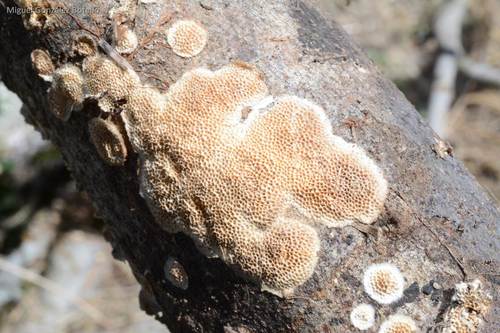
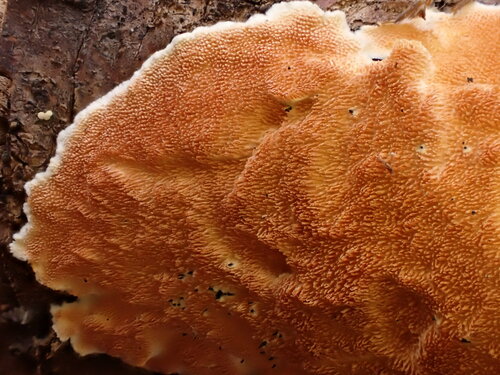
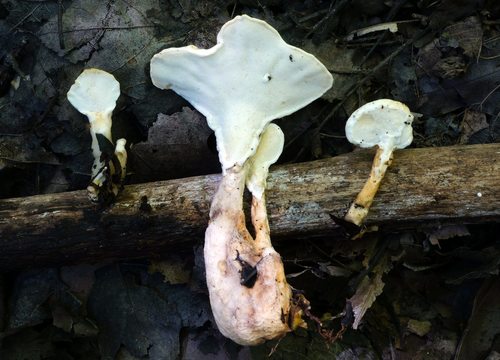
Fruit bodies of Loweomyces fractipes vary considerably in form. The stipe grows from a central to lateral position; fruit bodies can be dimidiate with fan-shaped to kidney-shaped caps, or almost effused-reflexed. Caps measure 1–4 cm wide and 1–5 mm thick, are soft when fresh, and become brittle when dry. The upper cap surface is white in young specimens, turning yellowish as it ages. It is initially finely tomentose, becoming more adpressed and semi-glabrous with age, often somewhat wrinkled, and usually azonate. When present, the stipe is white to yellowish, up to 4 cm long, and ranges from cylindric to flattened, expanding toward the cap. The pore surface is white to cream, made up of tiny angular pores that number 4–5 per millimetre. The context of both the cap and stipe is white, and has two distinct layers: a hard inner or lower layer covered by a much looser layer that may become agglutinated on the surface with age. The tube layer matches the pore surface in colour, and grows up to 3 mm thick. The hyphal system is monomitic, containing only generative hyphae. All these hyphae have clamp connections. In the subhymenium and trama, hyphae are thin-walled and 3–5 μm in diameter. In the context, and especially in the stipe, hyphae are much thicker-walled and resemble skeletal hyphae, but still have scattered clamps. Ryvarden interprets these thick-walled hyphae as sclerified generative hyphae. Cystidia are variably present in the hymenium, and are often difficult to observe under microscopy. They are thin-walled, shaped ventricose to cylindrical, and measure 15–25 by 5–6.5 μm. Basidia are broadly club-shaped, have four sterigmata, and have a basal clamp; they measure 15–20 by 6–9 μm. Spores range in shape from broadly ellipsoid to egg-shaped to roughly spherical, and measure 4.5–6 by 4–5 μm. They are slightly thick-walled, smooth, hyaline (translucent), and do not react with Melzer's reagent. Loweomyces fractipes occurs in Europe, North America, Costa Rica, Brazil (South America), and Korea.