About Loweia tityrus (Poda, 1761)
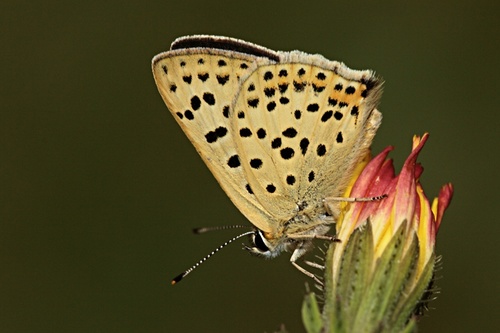
This description, originally sourced from Seitz, covers the butterfly currently known as Loweia tityrus (Poda, 1761), originally referenced under the name C. dorilis Hufn. with synonyms circe Schiff., garbas F., phocas Rott., dorylas Kirby. Males are black-brown on the upperside, with a striking metallic green gloss when alive. They have black spots that align with spots on the underside, and a very thin reddish lunate line before the margin of the hindwing. Females are similar in upperside pattern to phlaeas, but are paler yellow, and have a very thin black edge instead of a broad black marginal band. The underside is yellowish grey, marked with numerous black ocelli and small russet-red spots before the margin. This species occurs across most of Europe, from the North Sea to the Mediterranean, excluding Great Britain; it is also found in Asia Minor. The much larger subspecies subalpina Spr., with synonyms xanthe F., montana M.-Durr, has an underside that is more plumbeous grey than yellowish grey, and has reduced red submarginal spots; it is found in the Alps. In contrast, the subspecies orientalis Stgr. has a more yellowish underside, and the female's upperside is entirely blackish; this form ranges from Anterior Asia to the Altai. bleusei Oberth., now classified as the full species Lycaena bleusei, is much brighter on the upperside, with stronger yellow variegation, and its hindwing has a short triangular tail; it occurs in Castilia. Multiple abnormal forms of this species have been documented. Ab. obscurior S. L. (synonym fusca Gillm.) are individuals with abnormally dark uppersides: males lack the red submarginal band on the hindwing upperside, and females from this form are dark like the males. Ab. albicans Fuchs (synonym nyeni Ter Haar) has a more extended light yellow area on the forewing. Both of these forms are entirely inconstant. Two other pale forms are occasionally observed: a yellow form (ab. fulvior Stef.) and a white form (ab. upoleuca Verity). In ab. strandi Schultz, the submarginal dots on the underside are modified into stripes. Ab. brunnea Wheel. is an aberration of subalpina in which the dark upperside lacks the coppery sheen seen in fresh, typical subalpina. The ab. caeruleopunctata aberration found in phlaeas corresponds to ab. brantsi Ter Haar (synonym purpureopunctata Wheel.) in this species, which has a row of whitish dots on the hindwing upperside before the outer third. Ab. nana Wheel. is only a dwarfed form. In ab. fulvomarginalis Schultz, the narrow red-yellow band on the male's hindwing upperside is also extended onto the forewing. The egg is semiglobular, dull green, somewhat darker at the top, and coarsely punctured. The larva is light green, minutely dotted with whitish, occasionally has a violet sheen on its back, and some specimens bear very small red markings. It hibernates, and feeds until April and again in the summer, on Rumex. The pupa is greenish or brown, with a dark dorsal line, lighter sides, and very small dark dots. Adult butterflies are active throughout the summer; in the southern portion of their range there are three overlapping broods. They can be found on roads through fields, and on wide, sunny forest roads. They visit flowers of Potentilla, Ranunculus, Chrysanthemum, Thymus and Leontodon depending on the season. Though they are not confined to specific flight locations, they sometimes occur together in large numbers. In the Alps, subalpina ascends to considerable elevation (Seiser Alp). In some localities, this species flies alongside alciphron, so Mackee considers certain intermediate specimens to be hybrids (ab. xanthoides).