About Loudetia simplex (Nees) C.E.Hubb.
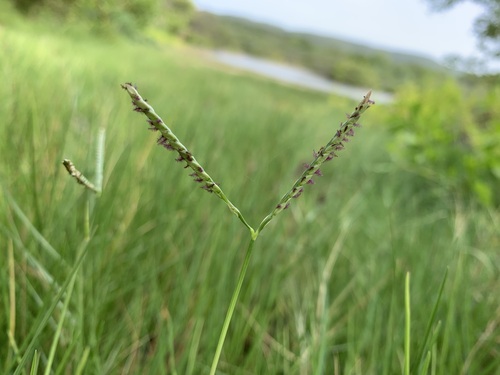
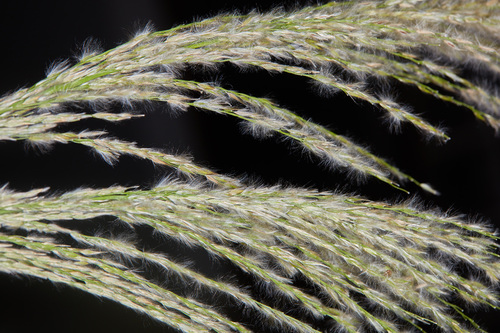
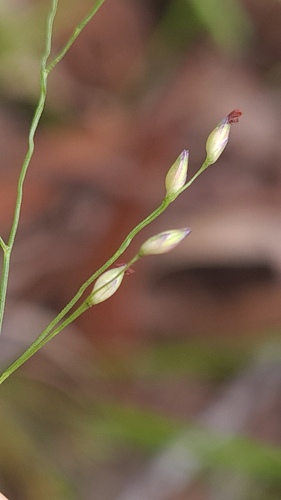
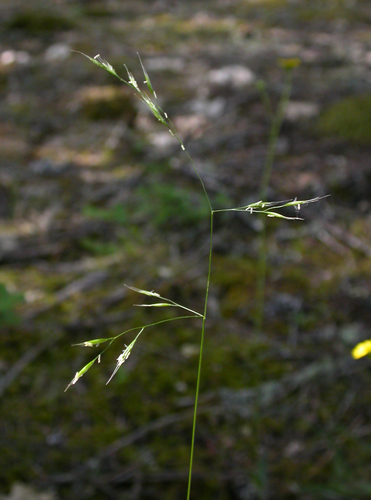
Loudetia simplex (Nees) C.E.Hubb. is a grass species native to tropical Africa, Southern Africa, and Madagascar. It was first described as a species in the genus Tristachya by Christian Gottfried Daniel Nees von Esenbeck in 1841, and later transferred to the genus Loudetia by Charles Edward Hubbard in 1934. This species is a perennial bunch grass with erect culms that grow 30–150 cm (12–59 in) long. Most of its leaves grow at the base of the plant, with flat, convolute blades that measure 10–30 cm (3.9–11.8 in) long and 2–5 mm wide. Its inflorescence is a panicle of spikelets 10–30 cm (3.9–11.8 in) long; each spikelet holds one sterile flower and one fertile flower. The lemma has an awn that is 25–50 mm long. Like all species in the genus Loudetia, L. simplex uses C4 photosynthesis. It grows in open habitats, frequently on poor, shallow soils, and is considered a significant weed. Two subspecies of L. simplex have been described: Loudetia simplex subsp. simplex and Loudetia simplex subsp. stipoides. In Madagascar, L. simplex is one of the dominant grassland species on the central high plateaus. It grows on leached, poorly drained soils there and is quite fire-resistant. Local Malagasy names for this species include horona, horo, berambo, kilailay, kirodrotra, and felika. As a pasture grass, it has only medium value.