About Lotus maritimus L.
Dragon's-teeth, formally Lotus maritimus L., is a herbaceous perennial plant with prostrate or decumbent stems that curve upward at their tips. Its branched stems reach roughly 30 cm in length. The leaves are alternate, each bearing three leaflets at the end of a short petiole (leaf stalk) around 0.5 cm long. The leaflets themselves are sessile (lacking their own stalks), 10–30 mm long by 4–15 mm wide, shaped oblanceolate, and covered in fine hairs. Two ovate stipules, around 10 mm long, grow at the base of the petiole.
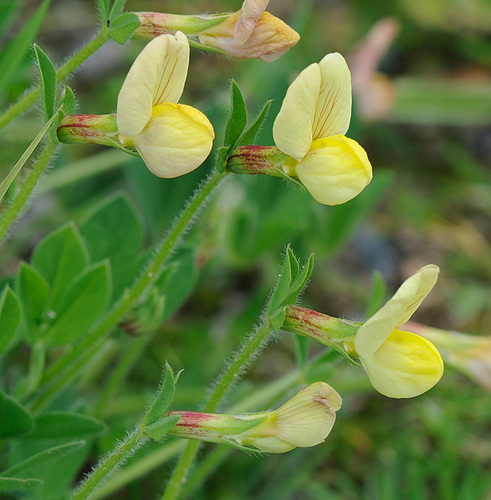
Flowering occurs in spring and summer, from May to August in Britain. Inflorescences grow from the leaf axils, bearing just one or two flowers on a stalk (peduncle) that is noticeably longer than the adjacent leaf. Each flower is subtended by a 3-lobed bract with narrow, pointed lobes. The flower has a reddish-green, hairy calyx that grows up to 15 mm long, splitting halfway down into 5 unequal, pointed teeth. The corolla measures 25–30 mm long: it has a pale yellow standard marked with reddish veins, and darker yellow wings and keel. Flowers have 10 stamens and one style. The superior ovary matures into a 4-winged, sword-shaped fruit roughly 50 mm long. Fresh fruits are light green; they turn brown, woody, and brittle when ripe. The dehiscent fruit holds many small, round seeds around 2 mm in diameter.
Dragon's-teeth is native to central to southern Europe, North Africa, and western Asia. Its range extends north to Britain and Scandinavia, where populations are often transient. It is sometimes classified as an introduced species here. While there has been speculation that it arrives as a contaminant in seed mixes, its presence in calcareous grassland nature reserves, shingle beaches, and chalk pits does not strongly support this origin. It may equally be a native plant expanding its range naturally into these northern areas.
Though it is a perennial, dragon's-teeth typically grows in locations with bare ground suitable for seedling establishment, including path edges, sandy beaches, and shingly beaches. In these habitats it often behaves more like an annual, reproducing by seed rather than forming permanent, long-established populations.