About Loriotus luctuosus (d'Orbigny & Lafresnaye, 1837)
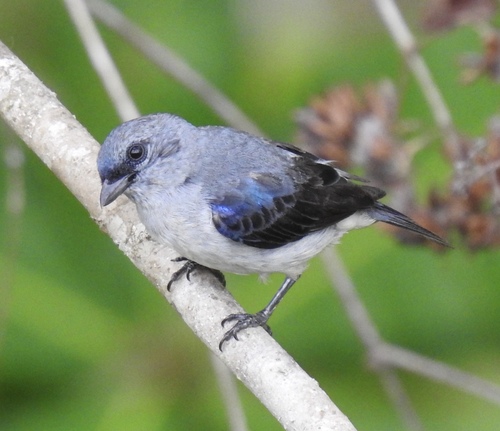
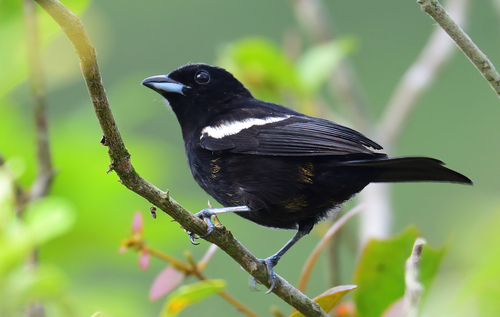
The white-shouldered tanager, with the scientific name Loriotus luctuosus, is a medium-sized passerine bird. This tanager is a resident breeder across its range, which extends from Honduras to Panama, continues through South America south to Ecuador and southern Brazil, and also includes the island of Trinidad. It lives in forests and cocoa plantations. It builds a bulky cup-shaped nest in low vegetation, and the female lays three cream-colored eggs marked with brown blotches. Adult white-shouldered tanagers measure 14 cm in length and weigh 14 g. They have long tails, and a mostly black, stout, pointed bill. The adult male has glossy black plumage overall, except for white underwing coverts and a clearly visible, prominent white shoulder patch. This prominent shoulder patch is the clearest difference between this species and the similar but larger white-lined tanager; in the white-lined tanager, the smaller white shoulder area is rarely visible except when the bird is in flight. Female and immature white-shouldered tanagers have olive-colored upperparts, yellow underparts, and a grey head and neck. White-shouldered tanagers are restless birds. Their diet consists mainly of insects, including stick insects, but they will also eat fruit occasionally. They often join with other insect-eating birds to form wandering mixed-species feeding flocks. The song of the white-shouldered tanager is a fast, repetitive tchirrup.