About Lophura ignita rufa (Raffles, 1822)
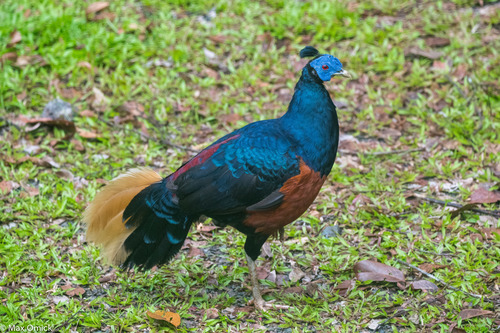
Description: The Bornean Crested Fireback, subspecies Lophura ignita rufa, shares the typical body plan of most galliform species: it is a heavy-bodied, ground-dwelling bird. Like other species in the genus Lophura, L. ignita rufa has bold strong coloration, with dark plumage that contrasts with bright vibrant accents. Distribution: This subspecies is endemic to Borneo, and occurs across most of Borneo's lowlands, including areas of Malaysia (Sabah and Sarawak), Brunei, and Indonesia (Kalimantan), as well as on Bangka Island off southeastern Sumatra. It is non-migratory, and maintains a consistent distribution throughout the year. Habitat: The ideal habitat for the Bornean Crested Fireback is lowland forest and rainforest undergrowth, though individuals have also been observed in logged forest in Sabah and western Sarawak, showing that the subspecies has some tolerance for forest degradation. It is usually found at relatively high elevations, with recorded elevations ranging from 600m in Sabah to 1300m across Borneo, though the full extent of its elevation range is contested and unclear. It occurs at higher elevations than the related species Lophura pyronata, the Bornean crestless fireback. Larger, interconnected forest patches can support larger groups of Bornean Crested Fireback, along with a greater diversity of other galliform species. Forest patches smaller than 4400 hectares almost never support any galliform species, indicating these birds require large areas of habitat to survive. Currently, significant portions of the Bornean Crested Fireback's range are affected by human encroachment and illegal logging. Reproduction: Male Bornean Crested Firebacks perform wing-whirring courtship rituals. These rituals signal the male's presence to females and mark the male's territory. Males produce wing beats at a rate of 12 beats per 1.2 seconds, creating a low-pitched rumble that can travel through dense undergrowth. Males may also make cackling or squealing calls. Males are territorial, and are known to use the spurs on their feet to compete with other males for mates and territory. The reproductive behaviour of this subspecies in the wild remains understudied. Current observations suggest that its breeding period is either not seasonally controlled, or is extended compared to the average for related galliforms. Egg-laying has been reported in July and August in Sabah, while reports from West Kalimantan place egg-laying in February and March. Moult patterns and visual observations tentatively indicate an overall breeding season from February to August. Nests have been found between the roots of trees, and are typically shallow crevices lined with feathers, dead leaves, grass, or bamboo. Eggs are gray or cream, sometimes marked with brown spots, oval in shape, and measure approximately 51.3 x 37.4mm. Very few wild nests have been documented, but clutch size is estimated to be around 6 eggs. The incubation period for wild Bornean Crested Fireback is unknown, but captive individuals of this taxon have an incubation period of 24 days. Chicks are precocial when they hatch. They have dark brown down on their upper side, and are white or reddish on their underside, with a reddish crown. Like common in pheasants, only the female cares for the chicks.