About Lophostrix cristata (Daudin, 1800)
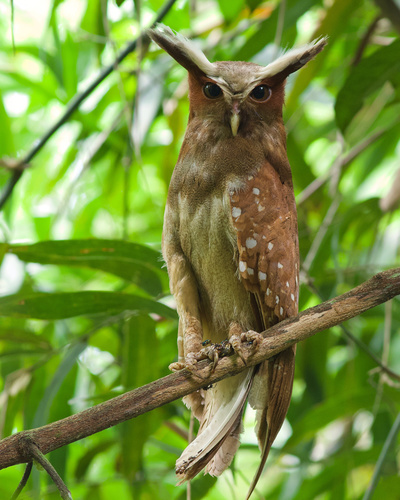
Lophostrix cristata, commonly known as the crested owl, is a medium-sized owl species. Adults measure 38 to 43 cm in total length and weigh 425 to 620 grams. It can be easily identified by its very long white or buff ear tufts, plus a prominent whitish eyestripe that extends into the ear tufts. Adult iris color ranges from yellow to brown, mottled with rufous. The bill is typically yellow or darker, and the toes are pale grey-brown. Juvenile crested owls have whitish down feathers (mesoptiles), dark facial disks, and short ear tufts. Juvenile flight and tail feathers match those of adults. This species is a non-migratory resident across its range in Central America and northern South America. It has been recorded in Belize, Bolivia, Brazil, Colombia, Costa Rica, Ecuador, El Salvador, French Guiana, Guatemala, Guyana, Honduras, Mexico, Nicaragua, Panama, Peru, Suriname, and Venezuela. It occurs throughout most of the Amazon Basin, excluding the north-west basin region that includes western Guyana, Venezuela, and central-eastern Colombia. Its natural habitats are subtropical or tropical moist lowland forest and subtropical or tropical moist montane forest, found up to 1000 m in altitude. It is more abundant in areas with undergrowth and snags, and it prefers locations close to water. While crested owls favor old growth forest, they also live in undisturbed secondary growth forest. They are most abundant in old floodplain forest, and least abundant in primary seasonally flooded swamp forest. In Mexico, this species lives in tropical evergreen and semi-deciduous forests, riparian areas, clearings, and foothills.