About Lophospermum erubescens D.Don ex Sweet
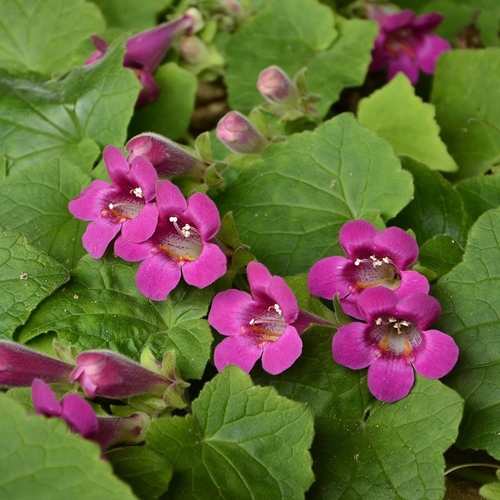
Lophospermum erubescens is a climbing herbaceous perennial plant with fibrous roots. It climbs using twining leaf stalks called petioles, rather than tendrils or twining stems. Its long branched stems become woody at the base as they age, and develop a woody caudex, which is a swollen, bulb-like structure at the stem base. Leaves have petioles 30–65 mm (1.2–2.6 in) long; the leaf blades are triangular or heart-shaped, 45–153 mm (1.8–6.0 in) long by 45–150 mm (1.8–5.9 in) wide, with a pointed apex and toothed edges that are either dentate or crenate. Both leaves and stems are sparsely covered with short hairs. In its native habitat, Lophospermum erubescens flowers and fruits over a long period from April to the following January. Flowers are borne singly. The calyx is made up of broadly ovate sepals that are 19–26 mm (0.7–1.0 in) long and 9–15 mm (0.4–0.6 in) wide at the base, joined only for the first 2–3 mm (0.08–0.12 in). Sepal margins curve outwards along around a third to half of their length. Flowers have five petals, joined at the base to form a tube 48–63 mm (1.9–2.5 in) long that is whitish at the base and pinkish-red to red towards the end. The free petal lobes at the end of the petals bend outwards. Two prominent folds called plicae run along the length of the base of the flower tube, and bear numerous yellow hairs 1–2 mm (0.04–0.08 in) long. There are four fertile stamens: the upper two are slightly longer than the lower two, plus one rudimentary infertile stamen. The style has a forked stigma. The ovary is covered with glandular hairs and has two chambers called locules. After fertilization, a more-or-less symmetrical globe-shaped seed capsule forms, filled with brown seeds, each of which has a circular "wing" around it. Lophospermum erubescens is native to the Sierra Madre Oriental mountains of Mexico, where it occurs at elevations between 1,000 and 2,200 m (3,300 and 7,200 ft). It grows on the margins of seasonally dry oak or oak-Liquidambar forests, including forest edges created by roads, and on canyon walls. Through widespread cultivation, it has become naturalized in many tropical and subtropical areas across the world, including Central America (Costa Rica and Panama), the Caribbean (Puerto Rico and Jamaica), South America (Venezuela, Colombia, Ecuador, Peru and southern Brazil), Hawaii, the Azores, Madeira, Madagascar and Réunion, Australia (New South Wales and Queensland), New Zealand (North Island), New Caledonia, Java and New Guinea. Lophospermum erubescens is pollinated by hummingbirds. Its flowers have characteristic adaptations to this pollination method: sturdy, long-tubed pink to red flowers with open throats that are more-or-less radially symmetrical. The nectar it produces also matches that of hummingbird-pollinated plants, being high in sucrose and low in glucose relative to fructose. Lophospermum erubescens has been in cultivation since it was first formally described in 1830. In 1836, Joseph Paxton wrote that it was "a very fine creeper, and deserves growing by every lover of plants." Growing to 2 m (7 ft) or more, it is described as "easy" to grow in frost-free locations. In areas that experience frost, it will survive if cut back to near ground level and its base and roots are protected from freezing over winter. It can be propagated by seed or cuttings. In cultivation, all-white flower forms are known, including the cultivar 'Bridal Bouquet'. In horticulture, it is often classified under the genus Maurandya, as noted for example in the RHS Horticultural Database. However, Lophospermum and Maurandya are now regarded as separate genera. Maurandya has smooth rather than hairy leaves with entire rather than toothed margins, and smaller flowers with a tube that is at most about 30 mm (1.2 in) long. This plant has won the Royal Horticultural Society's Award of Garden Merit.