About Lophophora diffusa (Croizat) Bravo
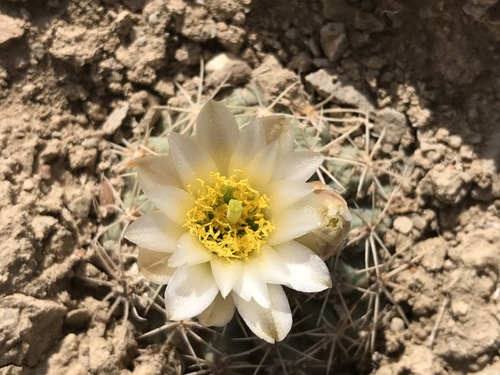
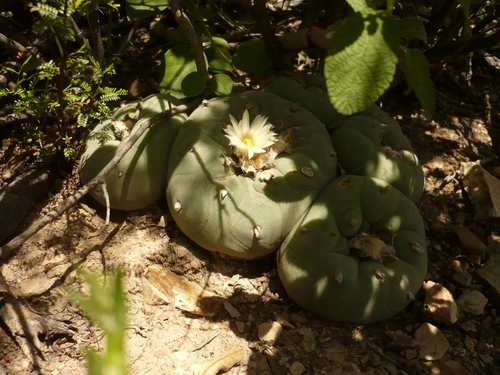
Lophophora diffusa (Croizat) Bravo typically grows either as a solitary plant or in clustered groups. It produces yellow-green, soft, somewhat flattened succulent stems that grow 2–7 cm (0.79–2.76 in) tall and 5–12 cm (2.0–4.7 in) in diameter. Its podaria are broad and flat, and are rarely elevated. This species has no ribs, and its wide, flat cusps bear small 2–3 mm areoles that do not produce spines. It has a broad, shallow, tuber-like root, and tufts of hair are unevenly distributed across the plant. Its flowers range in color from white to slightly pink or yellowish-white, and measure 1.3–2.2 cm (0.51–0.87 in) in diameter.
This species is the southernmost member of the genus Lophophora. It grows in limestone soils across a small area of approximately 775 km² (299 sq mi) located between Vizarrón, Bucareli, and Tolimán in Querétaro, Mexico, with small additional populations found in Hidalgo. Its natural habitat is semi-desert on slopes, river beds, and in the shade of various shrubs and nurse plants including Larrea tridentata and Senegalia sororia. It grows at altitudes between 1,000 and 2,000 metres (3,280–6,560 ft) above sea level, forming isolated, self-sustaining populations in the Estórax River depression. Lophophora diffusa is classified as vulnerable, due to its extremely small distribution range, total population of fewer than 3,000 individuals, and ongoing illegal collection. It is harvested illegally both by people seeking peyote and for use as an ornamental plant.