About Lophaetus occipitalis (Daudin, 1800)
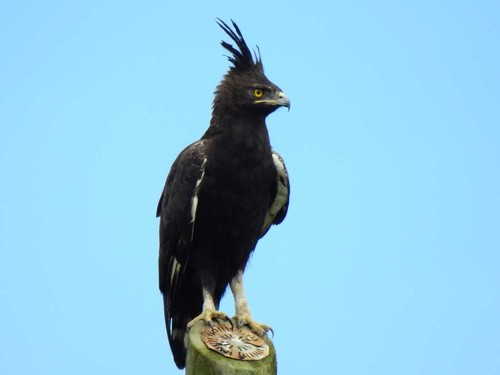
The long-crested eagle, with the scientific name Lophaetus occipitalis (Daudin, 1800), is often called Kamusungu-sungu in Uganda. When perched, it is easy to identify by its long, shaggy crest and entirely dark plumage. Adult long-crested eagles have blackish-brown plumage; long, thin feathers grow from the back of the crown and are held upright to form the distinctive crest. Their secondary feathers are black, marked with light grey barring and broad black tips. The primary feathers and median underwing coverts are white, which creates a noticeable white patch on both the upper and lower wing surfaces that is visible when the bird is in flight. The tail is black with pale grey barring. Adult eyes are bright yellow, though female eyes may be darker; the cere and feet are yellow, and these parts pale to white in males. Juveniles resemble adults, but their plumage is lighter in colour, their crest is not fully developed, and their eyes are grey. The species has a body length of 53 to 58 centimetres (21 to 23 inches). Females weigh between 1,300 and 1,500 grams (46 to 53 ounces), while smaller males weigh between 912 and 1,300 grams (32.2 to 45.9 ounces). This eagle is found across sub-Saharan Africa, ranging from Senegal and Gambia eastward to Ethiopia, and southward to the Eastern Cape in South Africa, northern Namibia and northern Botswana. It is generally a sedentary species, but may become nomadic in arid areas depending on rainfall. The long-crested eagle inhabits forest edges and moist woodland, especially when these habitats are located near grassland, marsh, a river or a stream. It can also be found in drier woodland, mixed farmland, grazing land, the edges of sugar-cane plantations and orchards, and will use exotic plantations of pine or eucalyptus as well. Its altitude range extends from sea level to 3,000 metres (9,800 feet), though it is uncommon to find individuals above 2,000 metres (6,600 feet). Rodents make up as much as 98% of the long-crested eagle's diet. In southern Africa, recorded rodent prey include the greater cane rat (Thryonomys swinderianus), vlei rats (Otomys spp.), the African marsh rat (Dasmys incomtus) and the four-striped grass mouse (Rhabdomys pumilio). Birds (including owls and the young of other raptors), frogs, lizards, invertebrates, and even fish and fruit have also been recorded as part of the species' diet. The long-crested eagle is a "sit and wait" hunter: it scans the ground from a perch, then swoops down on prey in a gliding flight.