About Lontra felina (Molina, 1782)
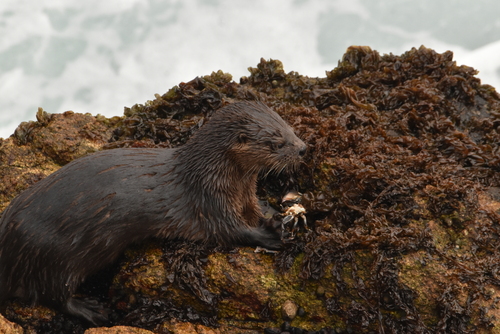
The marine otter, scientifically Lontra felina (Molina, 1782), is one of the smallest otters and the smallest marine mammal. It measures 87 to 115 cm (34 to 45 in) from nose to the tip of the tail, with the tail alone measuring 30 to 36 cm (12 to 14 in), and weighs 3 to 5 kg (6.6 to 11.0 lb). Its fur is coarse: guard hairs reach up to 2 cm (0.79 in) in length, covering a dense, insulating underfur. The species is dark brown on its upper body and sides, and fawn on the throat and underside. It has webbed paws with strong claws, and the ventral (underside) of the paws is partially covered in fur. It has 36 teeth with a dental formula of 3.1.3-4.1 / 3.1.3.2, and its teeth are adapted for slicing rather than crushing. The marine otter shows no sexual dimorphism.
Marine otters are distributed along the littoral areas of southwestern South America, staying close to shore in the intertidal zone. Their range extends from the port of Chimbote in northern Peru, along Chile's entire coast, to the extreme southern coast of Argentina. Occasional vagrant individuals have been sighted as far away as the Falkland Islands. They mainly inhabit rocky shorelines with abundant seaweed and kelp, and only rarely enter estuaries and freshwater rivers. Unlike many other otter species that prefer calm waters, marine otters select habitats with high exposure to strong swells and winds. They use caves and crevices in rocky shorelines for cover, and their holts (dens) often have no land access at high tide. They avoid sandy beaches entirely.
Rocky intertidal zones with natural crevices serve as both ideal dens and feeding grounds for marine otters. Since they spend most of their time hidden in caves, their behavior is difficult for researchers to observe. Marine otters actively avoid humans. When faced with human activity, they spend less time on coasts, and during the day they move away from their dens to fissures that humans cannot reach. Though they generally avoid people, their presence in fishing villages shows they are able to adapt to urbanization.
Marine otters may be either monogamous or polygamous. Breeding takes place in December or January. After a gestation period of 60 to 70 days, litters of two to five pups are born between January and March. Pups receive around 10 months of parental care from their mother, and can sometimes be seen resting on the mother's belly while she swims on her back, a behavior similar to that of the sea otter. Both parents bring food to pups and teach them how to hunt.