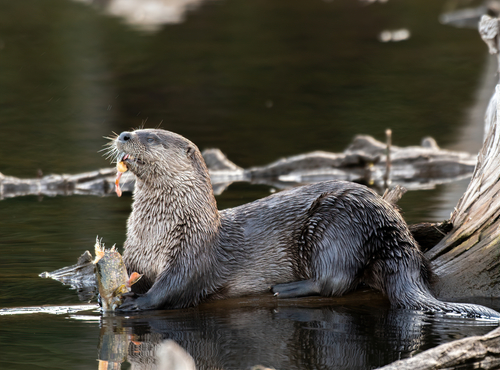
About Lontra canadensis (Schreber, 1777)
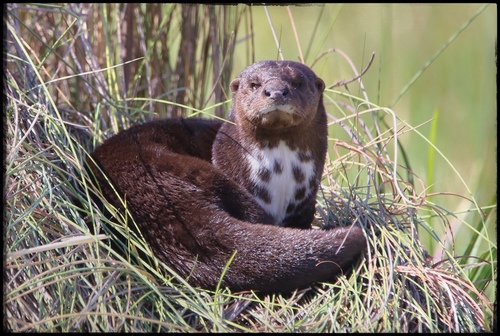
The North American river otter (Lontra canadensis) has long, thin whiskers that it uses to detect prey in dark water. Average adult males weigh around 11.3 kilograms (25 lb), while average adult females weigh 8.3 kg (18 lb); large males can weigh more than 15 kg (33 lb). Total body length ranges from 66 to 107 cm (26–42 in), with a long tapered tail that makes up roughly one-third of the total body length. Tail length ranges from 30 to 50 cm (12–20 in). This species can be told apart from the Eurasian otter by its longer neck, narrower face, smaller gap between the ears, and shorter tail. Male and female North American river otters differ in non-sexual physical traits, with males typically growing larger than females. In captivity, they live 21 to 25 years, while wild individuals live 8 to 13 years.
North American river otters are found across most of North America, where they live in inland waterways and coastal areas of Canada, the Pacific Northwest, Atlantic U.S. states, and U.S. states along the Gulf of Mexico, as well as forested regions near the North American Pacific coast. The species is present across all of Alaska, including the Aleutian Islands and the north slope of the Brooks Range. Urbanization and pollution have reduced the species' range in the United States; it is now absent or rare in Arizona, Kansas, Nebraska, New Mexico, North Dakota, Ohio, Oklahoma, South Dakota, and Tennessee. In recent decades, reintroduction projects have expanded the species' distribution, particularly in the Midwestern United States and West Virginia. After being reintroduced to Kentucky in the early 1990s, North American river otters recovered enough that a trapping season was established in 2006, and the species now occurs in all of the state's major waterways. In 2010, the Colorado Department of Wildlife reported that the species, reintroduced to the state in the 1980s, was thriving and recommended its protection status be re-evaluated. In late 2012, a river otter nicknamed Sutro Sam was found living near the former site of the Sutro Baths in San Francisco, marking the first sighting of the species in that city since the 1950s. All Canadian provinces and territories host North American river otters except, until recently, Prince Edward Island, where the species has recently begun to re-establish populations. In Minnesota, reintroduction efforts in the 1980s, improved water quality, habitat restoration, and regulated harvest have led to population rebound. While the species is most common in northern Minnesota, it can also be seen in urban areas including the Twin Cities.
Historical records show that prior to European settlement, North American river otters were abundant across most major drainages of the continental United States and Canada. The largest populations occurred in areas with plentiful, diverse aquatic habitats, including coastal marshes, the Great Lakes region, and the glaciated areas of New England. Riverine habitats in interior regions supported smaller populations. The species was originally present across all of the Pacific Coast, including the seashore, inland streams, and inland lakes. In Mexico, North American river otters once lived in the Rio Grande and Colorado River Deltas. Despite its common name of "river otter", this species lives in a wide range of both freshwater and coastal marine aquatic habitats, including lakes, rivers, inland wetlands, coastal shorelines, marshes, and estuaries. It can tolerate a broad range of temperatures and elevations, and is tied almost entirely to permanent watersheds due to its aquatic lifestyle. Its key habitat requirements are a consistent food supply and reliable access to a body of water. The species is sensitive to pollution, and will disappear from contaminated areas. Like other otters, the North American river otter lives in a holt (den), which it builds in abandoned burrows dug by other animals, or in natural hollows such as those under logs or within riverbanks. The den has an entrance that may be under water or above ground, which leads to a nest chamber lined with leaves, grass, moss, bark, and hair.
North American river otters use delayed implantation, a reproductive trait that distinguishes them from Eurasian otters, which do not use this strategy. In early spring, pregnant females search for a den to give birth in. Female otters do not dig their own dens, instead relying on other animals such as beavers to create suitable spaces for raising their offspring. Once a female has established her den site, she gives birth to a litter of kits. Litter size can be as large as five, but most litters contain one to three kits. Each newborn pup weighs approximately five ounces. Mothers raise their young without assistance from adult males. When pups are around two months old and their fur has finished growing in, their mother introduces them to water. North American river otters are natural swimmers, and with parental supervision, they quickly gain the skills needed to swim. Pups may leave the den at eight weeks old and are able to survive independently by autumn, but they usually stay with their family group (which sometimes includes the father) until the following spring. Before the next litter is born, year-old otters leave to find their own home ranges.