About Lonicera tatarica L.
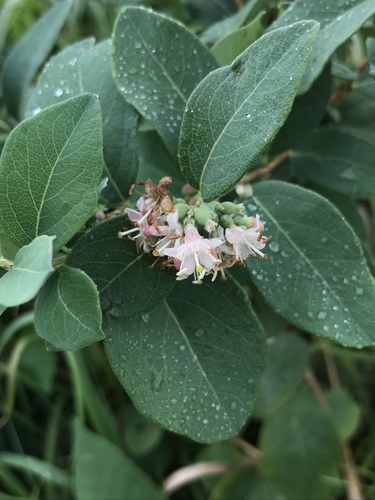
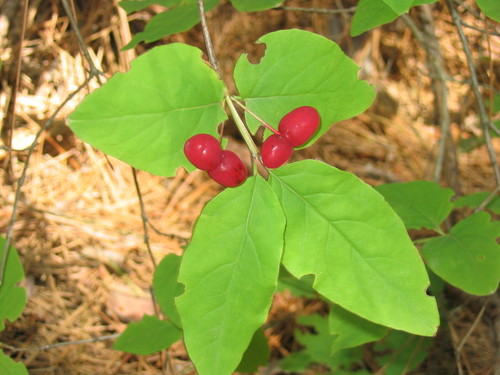
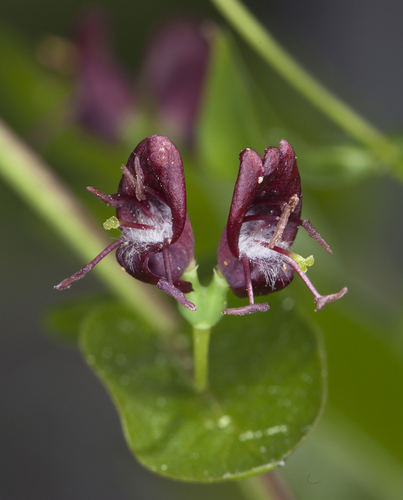
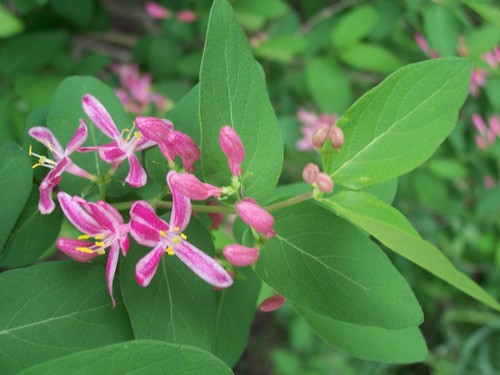
Lonicera tatarica is a bushy shrub that can grow close to 3 meters (10 feet) tall. Its twigs range in color from green to brown, and have a hollow brown pith. The plant bears simple, oval or rounded leaves that are 3 to 6 centimeters (1+1⁄4 to 2+1⁄4 inches) long; overall, leaves and stems range from 2.5–6.5 cm (1–2+1⁄2 in) long and 1.25–2.5 cm (1⁄2–1 in) wide. Leaves are egg-shaped, hairless, and toothless along the edges. Flower inflorescences range in color from deep rose to light pink, and may also be white. Petals are typically 2–2.5 cm (3⁄4–1 in) long, formed into a slender tube with two lips; the upper lip has 4 lobes, with the middle two lobes erect and fused near the base. Individual white, pink, or crimson red flowers are each about 1.5 cm (5⁄8 in) long, with protruding stamens and styles. The fruit is a shiny orange or red seed-containing berry less than 1 cm wide, and these berries are attractive to wildlife. The plant forms thickets and spreads easily when birds and other animals consume its fruits. The flowers have a sweet scent characteristic of honeysuckle. In cultivation, L. tatarica has hybridized with other shrubby Lonicera species: when crossed with L. morrowii, it produces the invasive hybrid L. × bella, and it can also hybridize with L. ruprechtiana and L. xylosteum. L. tatarica is native to Siberia and other parts of eastern Asia, particularly China, and also grows in the Himalayas. It was introduced to North America as an ornamental plant in 1752, and has since become a widespread introduced species and noxious weed found across the continent as far west as Alaska and California, where it grows easily in disturbed habitat. It prefers partial sun and moist, loamy soil, but can also grow in full shade, full sun, and dry or sandy soils. This species threatens native habitats because it grows quickly and forms thick, impenetrable mats that smother competing plants. It most commonly invades thickets, open woodlands, roadsides, and fence rows. Birds and mammals disperse its seeds, leading to rapid spread that often creates dense understory thickets which restrict native plant growth and reduce biodiversity. Once introduced, L. tatarica is difficult to control in natural areas because it grows at high density, and can suppress the growth of other native plants to form monocultures. Problems associated with L. tatarica invasion include depletion of soil moisture and soil nutrients, production of allelopathic chemicals that chemically alter native plant growth, and reduced density of native tree seedlings. The wood of this plant triggers a behavioral response in around half of all domestic cats; among cats that do not respond to catnip, one third respond to Tatarian honeysuckle. In its native habitat, Tatarian honeysuckle acts as a host plant for at least 16 Lepidoptera species, including Limenitis camilla, Limenitis helmanni, and Perittia sibirica. This species has a low level of poisonous severity to humans, with no reported fatal cases of consumption. Eating its berries is not recommended, as consumption causes symptoms including diarrhea, vomiting, and abdominal pain.