About Lonicera japonica Thunb.
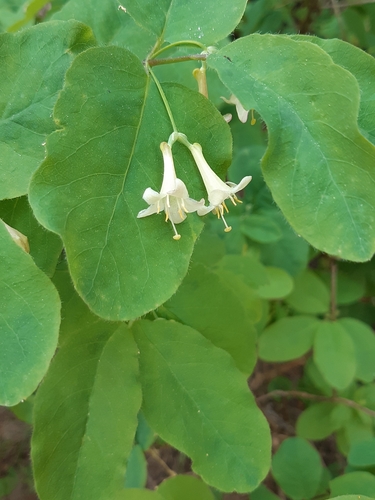
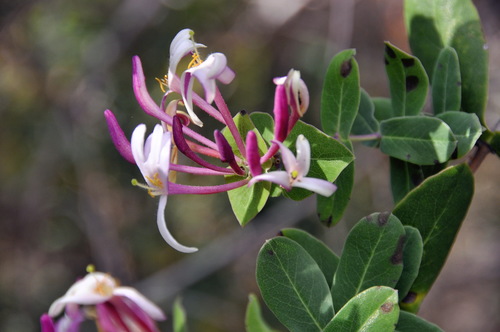
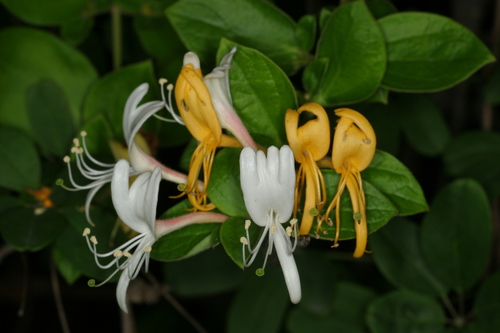
Lonicera japonica Thunb., commonly known as Japanese honeysuckle, is a twining vine that can climb up to 10 meters (33 feet) or higher up tree trunks. It produces opposite, simple oval leaves that measure 3–8 cm (1+1⁄4–3+1⁄4 in) long and 2–3 cm (3⁄4–1+1⁄4 in) wide. Young stems are slightly red and may have a fuzzy texture, while older stems are brown with peeling bark and are often hollow inside. The flowers are double-tongued: they open white, then fade to yellow as they age, and carry a sweet, vanilla-like scent. The species produces fruit in fall, which is a spherical black berry 3–4 mm (1⁄8–3⁄16 in) in diameter and holds a small number of seeds. In its ecology, the flowers of Lonicera japonica are a notable food source for deer, rabbits, hummingbirds, and other types of wildlife. All parts of this plant except for the flower nectar are potentially toxic. Despite being a highly invasive and destructive plant species, Lonicera japonica is commonly sold by nurseries in the United States as the cultivar 'Hall's Prolific' (also classified as Lonicera japonica var. halliana), and in the United Kingdom it is sold as the cultivar 'Halliana'. This cultivar is also called Hall's Japanese honeysuckle. It makes an effective groundcover and produces strongly scented flowers. It can be cultivated from seed, cuttings, or layering, and will spread on its own via shoots if it has enough growing space. The variety L. japonica var. repens has earned the Royal Horticultural Society's Award of Garden Merit. The flowers of Japanese honeysuckle are edible for humans, and people enjoy them for their sweet-tasting nectar. In traditional Chinese medicine, Lonicera japonica is called rěn dōng téng (忍冬藤, literally "winter enduring vine") or jīn yín huā (金銀花, literally "gold-silver flower"); the name gold-silver flower refers to the presence of flowers of different ages on the same plant, as each individual flower changes from white (silver) to yellow (gold). Other alternative Chinese names are er hua (二花) and shuang hua (雙花), both meaning double-[color] flowers.