About Lonicera involucrata (Richards.) Banks ex Spreng.
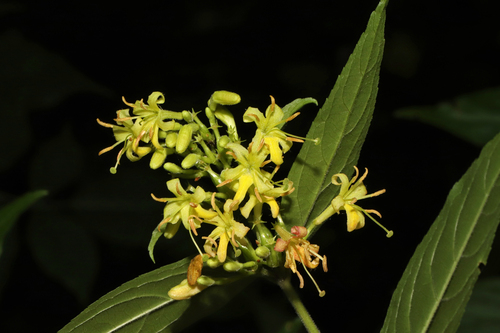
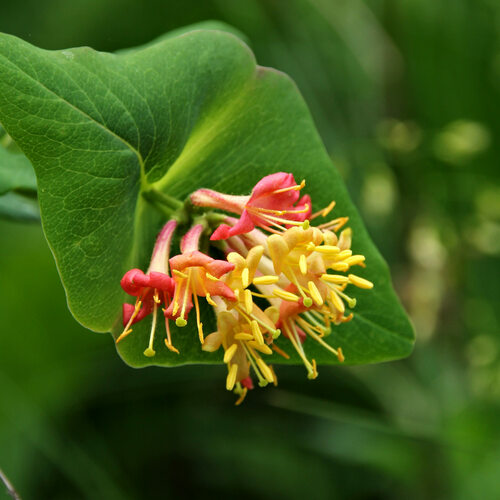
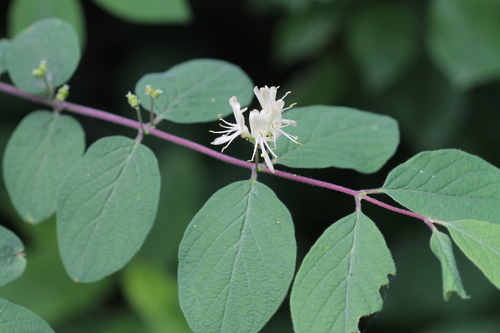
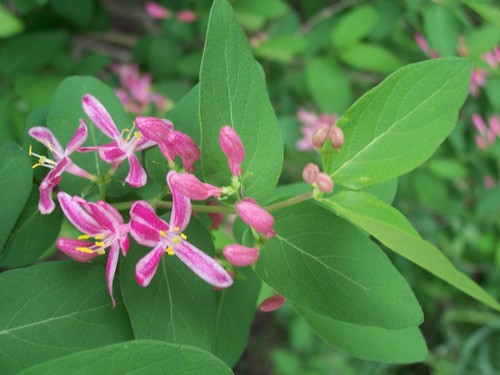
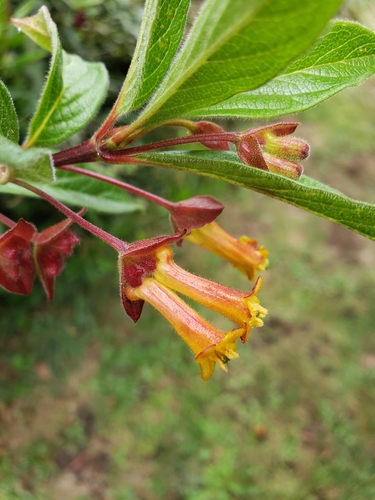
Lonicera involucrata (Richards.) Banks ex Spreng. is a large deciduous shrub ranging in height from 0.5 to 5 metres (1+1⁄2 to 16+1⁄2 feet). Its shoots have a quadrangular cross-section, and it bears opposite leaves that are elliptic to oval in shape, measuring 3–14 centimetres (1 to 5+1⁄2 inches) long and 2–8 centimetres (1 to 3 inches) broad. Leaves have hairs along their margins and undersides, and feature a distinct abruptly acuminate tip. Its yellow, tubular, hairy flowers are 1–2 centimetres long, monoecious, and grow in pairs from leaf axils. Each pair of flowers is subtended by a pair of reddish basal bracts that are 2–4 centimetres across. The plant produces a black berry 6–12 millimetres (1⁄4 to 1⁄2 inch) wide that contains several small seeds, ripening in mid-to-late summer. The berries are unpalatable. This species is distributed from southern Alaska, east across boreal Canada to Quebec, and south through the western United States to California, extending to Chihuahua in northwestern Mexico. It grows at elevations ranging from sea level up to 2,900 metres (9,500 feet). It inhabits moist, wooded areas, particularly clearings and wetland edges, and has a Wetland Indicator Status of FAC+, meaning it is equally likely to occur in wetlands and non-wetlands. In its ecosystem, the berries are eaten by bears, birds, and small mammals, while the flowers provide an important nectar source for hummingbirds, butterflies, and moths. Deer browse the plant's twigs and leaves. Across some parts of its native range, the plants are not abundant enough to serve as a staple food source for wildlife. The berries are considered probably inedible for humans, and possibly poisonous to people, even though some sources have reported otherwise. Indigenous groups of the Pacific Northwest Coast referred to this plant as 'monster food' and 'crow berry' for this reason. Lonicera involucrata is commonly used as an ornamental plant. It is resistant to air pollution and is suitable for planting in large gardens. It is also frequently used in ecological restoration projects across its native range, especially in riparian zones to stabilize stream banks. Several Native American groups including the Quileute, Kwakwaka’wakw, and Haida developed various uses for the plant. They used its berries to produce black pigment and hair dye. Poultices and teas were made from the plant's bark, berries, and leaves, and its bark was combined with willow bark for weaving clothing.