About Longitarsus jacobaeae Waterhouse, 1858
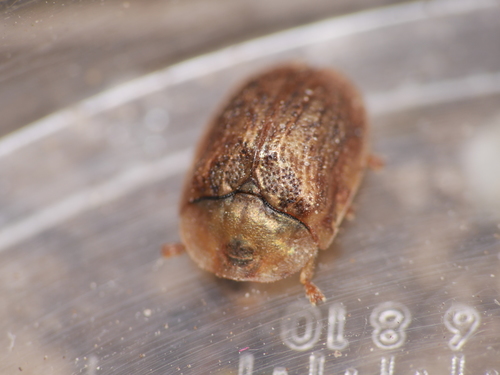
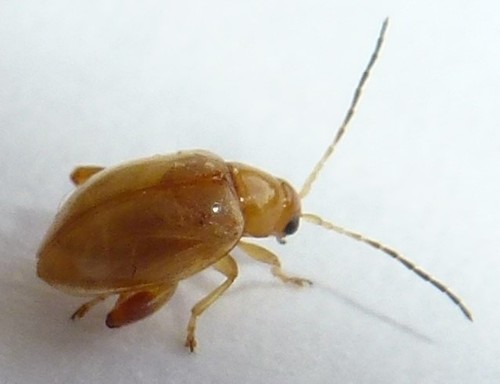
Longitarsus jacobaeae, a species of flea beetle, is commonly called the tansy ragwort flea beetle. It is used as a biological pest control agent against the noxious, nectar-rich weed ragwort, which was originally classified as Senecio jacobaea and later reclassified as Jacobaea vulgaris. Adult beetles are light golden brown and measure between 2 millimetres (0.079 in) and 4 millimetres (0.16 in) in length. Females are larger than males, and this difference is especially noticeable when females are gravid. The beetle has enlarged femurs that support its primary locomotion method of hopping. Females lay eggs on or near its host plant, ragwort. Larvae emerge after approximately two weeks and burrow into the ground to feed on the plant's roots. Both larvae and adult beetles contribute to damage to the host plant. Adult beetles defoliate plants that are often already weakened by root damage caused by larvae. This two-pronged attack is very successful at stopping ragwort growth and development, and the beetles have prevented entire ragwort populations from reaching the flowering stage at several monitored sites. This beetle is not selective between species within the plant genera it feeds on. Recent studies using this beetle have shown that selection pressure from specialist herbivores is not likely a driving force in the evolutionary diversification of alkaloid-containing plants that the beetle feeds on. The species is native to Eurasia. It was first introduced to the United States as a biocontrol agent for ragwort in 1969, and is now established across much of the western United States. It is most effective when used alongside the cinnabar moth (Tyria jacobaeae), another biocontrol agent targeted at ragwort. This beetle is not known to attack any other plant species. A closely related species, Longitarsus ganglbaueri, also feeds on ragwort but does attack other plant species, so it is not used as a biocontrol agent.