About Lomatia polymorpha R.Br.
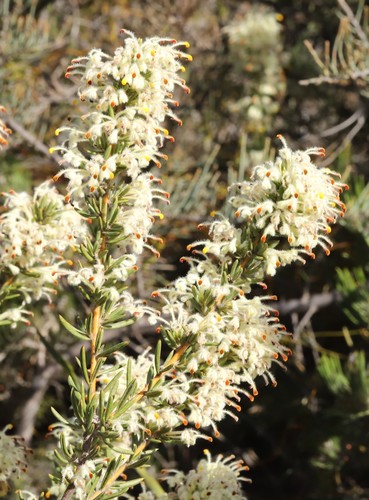
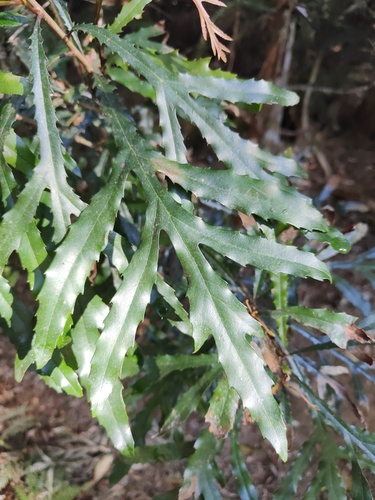
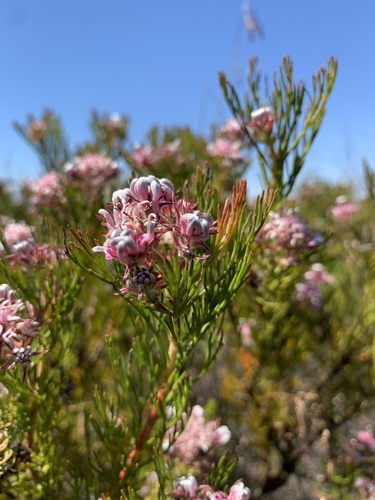
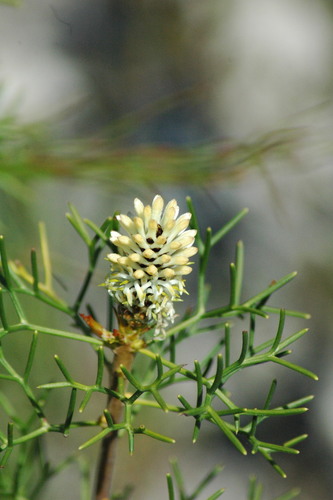
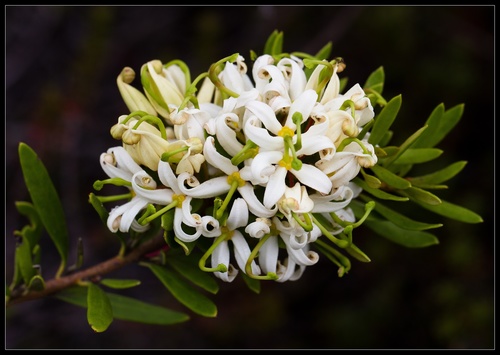
Lomatia polymorpha, commonly known as mountain guitar plant, is a shrub or small tree that grows to a height of 2.5 to 4 metres (8 to 10 feet). It has simple leaves that range in shape from linear to narrow egg-shaped, measuring 20–80 mm (0.8–3 in) long and 2.5–10 mm (0.1–0.4 in) wide. Each leaf has a stalk about 5 mm (0.2 in) long, and sometimes has a small number of lobes or teeth along its margins. Stems are sometimes covered in matted hairs, the lower surface of leaves is covered in rusty-coloured hairs, and leaves have a prominent mid-vein. Clusters (heads) of flowers barely extend past the leaves, and are white, cream, or greenish-white in colour. Flowering occurs between January and March, and is followed by the development of dark grey to black fruits that are 20–30 mm (0.8–1 in) long. This species is common and widespread, found approximately south of the Pieman River and west of the Derwent River. It grows in subalpine woodlands, lowland scrubby vegetation in wetter areas, and occasionally in rainforest, at elevations from sea level up to 1,200 m (4,000 ft). Where the range of Lomatia polymorpha overlaps with that of L. tinctoria, such as in the Lake St Clair region, hybrids often occur. In horticulture, Lomatia polymorpha is a hardy cultivated species. It can be grown easily from seed or cuttings, and grows well in most soil types and aspects.