About Lomatia ilicifolia R.Br.
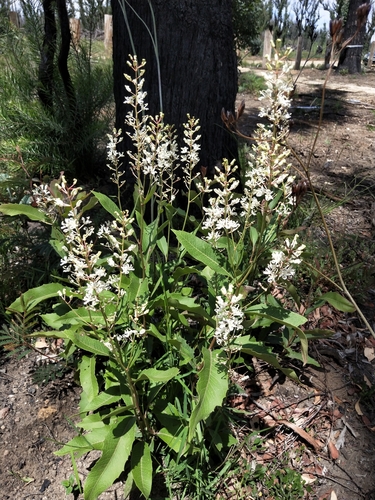
Lomatia ilicifolia R.Br. is a stiff, erect shrub that grows 0.5 to 3 meters (2 to 10 feet) tall. Its new foliage and flower buds are covered in rust-colored hairs. The leaves are dull green, leathery, and holly-like, mostly hairless, and shaped egg-shaped to lance-shaped or elliptic. They measure 6 to 20 centimeters (2 to 8 inches) long and 2.5 to 3.5 centimeters (0.98 to 1.4 inches) wide, with sharp teeth along the edges and a prominent network of veins.
Flowers grow at stem ends in a spike-like panicle or raceme that is 15 to 30 centimeters (6 to 10 inches) long. Each individual flower sits on a stalk 8 to 12 millimeters (0.3 to 0.5 inches) long. The flowers are white or cream-colored, 10 to 12 millimeters (0.4 to 0.5 inches) long, and more or less hairless. Flowering takes place from November to February, usually after fire the previous summer. About three months after flowering, the plant produces fruit: a dark brown, leathery follicle 15 to 30 millimeters (0.6 to 1 inch) long that holds around ten winged seeds. Hybrids with L. myricoides, L. silaifolia and L. fraseri occasionally form where these species grow near L. ilicifolia.
This species, commonly called native holly, is widespread and locally common in south-eastern Victoria, where it grows in heath or woodland, and sometimes in montane forests, ranging from the Otway Ranges east to Gippsland. In New South Wales, it grows in sclerophyll forest on the coast and nearby ranges south of Moss Vale. Ecologically, native holly attracts nectar-feeding butterflies. For horticultural use, this lomatia is a hardy, slow-growing plant with interesting foliage, well-displayed flowers, and attractive fruit. It tolerates frost and grows in full sun or partial shade.