About Lomaspilis marginata (Linnaeus, 1758)
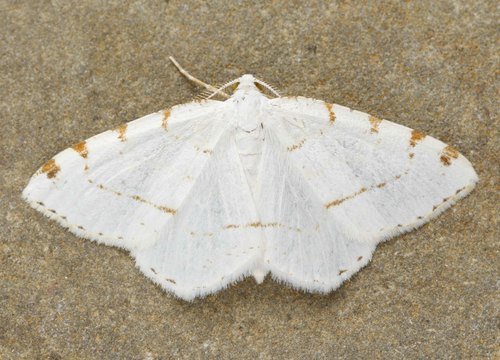
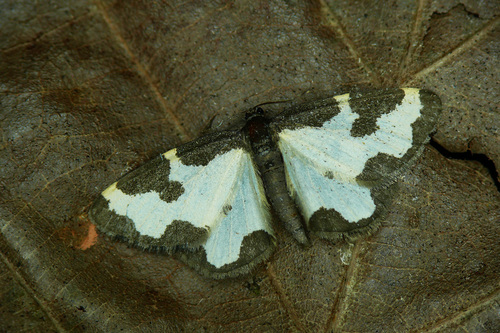
Lomaspilis marginata is a highly variable moth species with very distinctive white wings marked by black blotches along the wing margins. The extent of black marking varies between individuals: males usually, though not always, have more extensive black areas than females, and very rarely, almost entirely white or entirely black individuals occur. The wingspan of this species ranges from 24 to 28 mm. Linnaeus's original described form has a complete black border on both wings, with additional spots or patches at the base and middle of the forewing costa. Several aberrations are recognized: ab. nigrofasciata Schoyen has a complete median band (at least on the forewing) with a normal marginal area; ab. mediofasciata Hofner has a complete median band but no marginal band; ab. dumeei de Joannis also lacks the basal costal patch; ab. suffusa Prout has a ground color suffused with smoky yellow grey, with weak and blurred dark markings; ab. nigrounicolorata Haverkampf is entirely black; ab. pollutaria Hbn. has a narrow band of the original ground color at the distal margin, which reduces and splits the black marginal band into two parts; ab. subdeleta Ckll has a marginal band on the forewing that is almost or completely gone, leaving only narrow patches at the base and middle of the costa, with an unmarked hindwing; ab. conflua Strand has confluent costal patches that are also confluent with the marginal band, while the median area remains normal; ab. opis Btlr has three large, longer-than-broad median spots on each wing, and forms a local race in southeast Siberia and Japan. This moth flies at night during June and July, and is attracted to light. The egg is yellow-green with hexagonal reticulation. The larva is pale green with darker dorsal lines and a purplish anal spot; it usually feeds on aspen and sallow, and has also been recorded feeding on birch, hazel and poplar. The species overwinters as a pupa, and may sometimes remain in the pupal form for up to four years.