About Lomandra multiflora (R.Br.) Britten
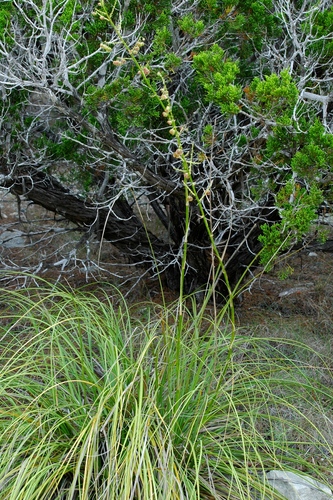
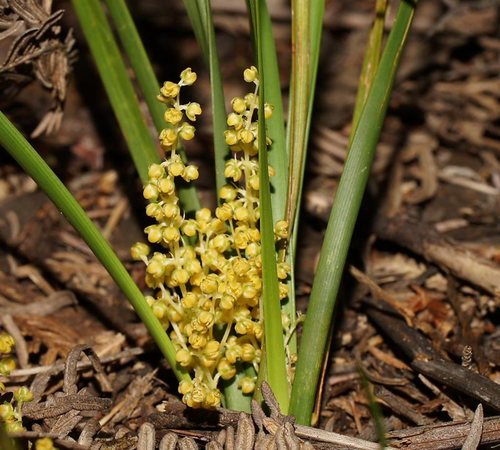
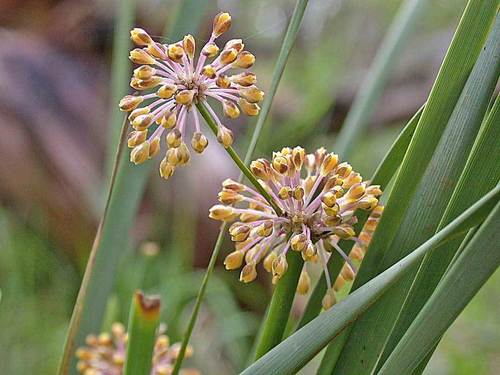
Lomandra multiflora, commonly called many-flowered mat-rush, mat rush, or many-flowered mat-lily, is a tufted, perennial, rhizomatous herb native to Australia. It belongs to the Australian-native Lomandra genus, which holds around 50 species that generally share common traits. There are two recognized subspecies: Lomandra multiflora subspecies dura, also known as stiff iron grass, and Lomandra multiflora subspecies multiflora. This is a small, grass-like tussocky plant with long, flat, rigid yellowish-green leaves. Leaves typically reach 30 to 50 cm in length, with a full growth range of 25 cm to 90 cm. The flat, smooth leaves grow vertically, are rounded at the apex, often slightly concave or convex, and measure around 2.5 to 4 cm wide. Leaf margins are brown, dry, membranous, and slightly rough to the touch. Subspecies multiflora has stiff narrow leaves 25–90 cm long, while subspecies dura grows strap-like leaves around 40 cm tall. Subspecies dura also differs by having flowers more hidden within the plant’s hard bracts. Lomandra multiflora is dioecious, meaning male and female flowers grow on separate plants, which is a distinct characteristic of the species. In spring, it produces creamy yellow flowers arranged in clusters at the base of the leaves. Flowers have 6 petals: inner petals are usually yellow, and outer petals are reddish brown. Flowers grow in dense clusters on branched or unbranched spikes that are often 25–75 cm long, with spiky white bracts. Male flowers are stalked, bell-shaped, smaller than the stalkless female flowers, and grow on branched stems, while female flowers grow on unbranched stems. The staminate (male flower) inflorescence is around 50–60 cm tall, with whorled branches 2 to 5.5 cm long. Male flowers are greenish yellow with 6 tepals: the 3 outer tepals measure around 1 mm long and 0.7–0.8 mm wide, while the 3 inner tepals are approximately 0.8 mm long, 0.5 mm wide, and thicker than the outer tepals. The pistillate (female flower) inflorescence is unbranched and around 28–30 cm long. Female flowers grow in clusters in whorls of up to 6, with clusters measuring up to 7.5 mm long. For female flowers, the 3 outer tepals are around 3.1 mm long and 2.9 mm wide, while the 3 inner tepals are 2.5 mm long and 1.5 mm wide. The fruit of Lomandra multiflora is a loculicidal capsule. When mature, the capsule usually contains a single asymmetrical seed that measures around 6–6.5 mm long, 3.3–4 mm across, and 5 mm deep. Dry seeds are grayish brown with faint transverse wrinkles. Lomandra multiflora shares very similar features with other Lomandra species, including Lomandra patens and Lomandra ramosissima. All three are robust tussock-forming plants with rounded to obtuse untoothed leaves, and male flowers grow in whorled branched clusters. However, Lomandra ramosissima can be told apart from Lomandra multiflora by its more branched female inflorescence and much shorter male flowers. Lomandra multiflora is distributed in New South Wales, Queensland, Victoria, South Australia, the Northern Territory of Australia, and Papua New Guinea. Subspecies multiflora occurs naturally in Southern Papua New Guinea, Western Melbourne, and the northeastern tip of the Northern Territory. Subspecies dura is only found in southern Australia, specifically in the Southern Flinders Ranges, Mt. Lofty Ranges, Yorke Peninsula, and Fleurieu Peninsula. The species grows mainly in woodland and open forest across a variety of soils, and is widespread primarily in drier areas of its range. It grows on substrates including clay soils over shale, basalt, and metamorphic rock, and occasionally on sandstone, in low to medium nutrient well-drained conditions. Optimal cultivation conditions for Lomandra multiflora include well-drained soils, a range of climates, and positions in full sun or semi-shade. It is a fire-retardant plant, and acts as both a facultative and obligate resprouter, meaning it relies on resprouting to regenerate after fire. It can be propagated easily from seed, or by division of clumps. Seeds take around 8–10 weeks to germinate without pre-treatment. Seed dispersal occurs via ants that are attracted to the seed’s elaiosome. The plant’s seeds are a food source for seed-eating birds, skinks, and lizards. It serves as food for native Australian butterflies, including Trapezites eliena and Trapezites petalia, as well as their caterpillars, and for moths. Lomandra multiflora subspecies dura is specifically a caterpillar food plant, and its seeds are also a food source for lizards. The plant attracts native bees, and is suspected of poisoning sheep. Historically, Indigenous Australian people used the species’ long leaves for basket making and other weaving, and consumed its nectar as food. As a fire-retardant plant that does not catch fire easily and resprouts from the base if burned, it can also be used to stabilize banks. It works well as a foreground plant in bush gardens, cottage gardens, and rockeries, as it withstands a range of conditions from frost and drought to brief swampy periods. It can also be propagated easily through stem tip cuttings. The fruit is a capsule that turns golden brown when ripe, and seed ripeness can be confirmed when the seed becomes firm and hard. To collect seeds, cut the stem and place it in a large paper bag in a warm location, and the capsule will open to release the seed. It can also be propagated through root ball division of existing clumps.