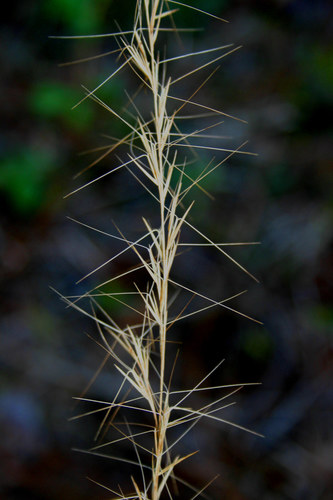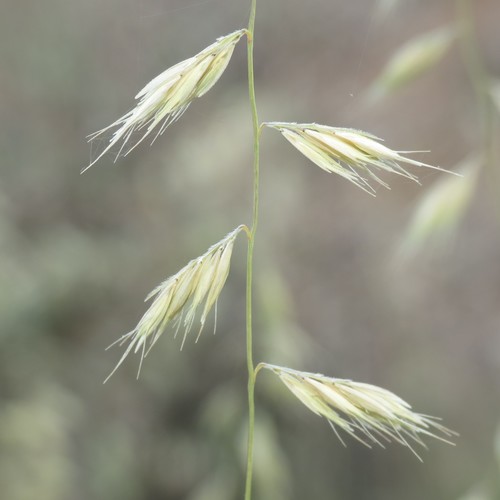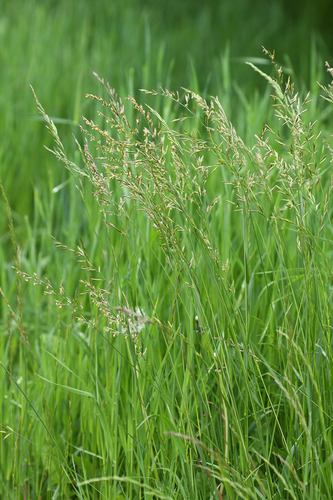
About Lolium pratense (Huds.) Darbysh.
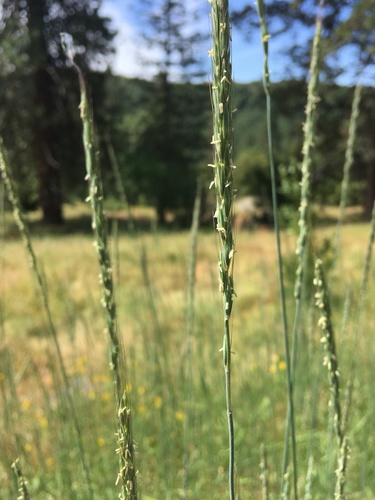
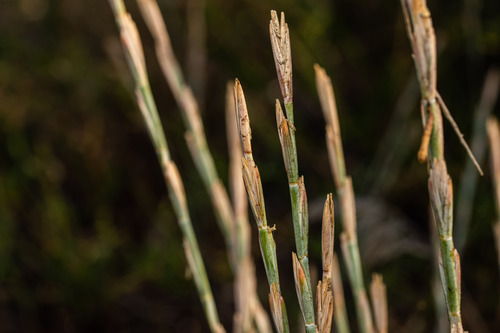
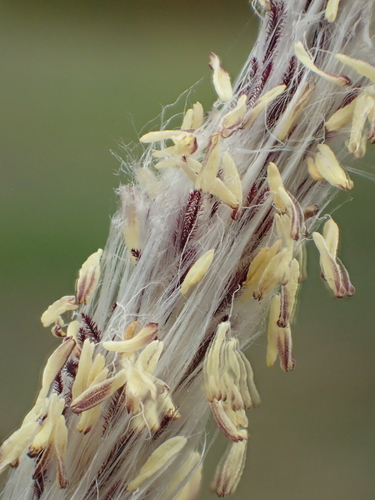
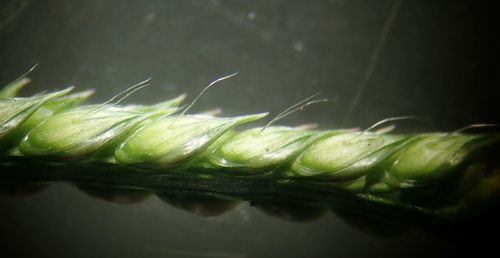
Meadow fescue, scientifically named Lolium pratense (Huds.) Darbysh., is a tuft-forming perennial bunchgrass known in the United States. It produces erect to spreading hollow, completely hairless (glabrous) flowering stems that grow up to around 1 m (3 ft) tall, and can exceptionally reach 120 cm. This glabrous texture extends to the leaf sheaths. At the top of each sheath, there is a 1 mm short ligule and pointed auricles that wrap slightly around the stem. The leaf blade is flat, up to roughly 8 mm wide, also glabrous, but rough along its upper surface and margins. Non-flowering tillers are typically shorter, but otherwise match the flowering culms in structure. Flowering normally takes place from June to August, producing an erect to slightly nodding open panicle that reaches about 30 cm (1 ft) long and is roughly one-sided. Panicle branches usually grow in pairs: the shorter branch bears only 1 or 2 spikelets, while the larger branch holds 4 or more. Spikelets measure 11–17 mm long, containing 5 to 10 (sometimes up to 16) bisexual florets, plus two short, unequal glumes. The lower glume has only 1 nerve, while the upper glume has up to 3 nerves. Lemmas are awnless or only shortly pointed. Each floret has 3 stamens with anthers around 3 mm long. The fruit is a caryopsis (nut-like fruit) with the seed tightly enclosed by the hardened lemma and palea. Meadow fescue is most similar to tall fescue, but differs from it by having only 2 spikelets on the smaller branch at the lowest panicle node, and lacking minute hairs on the auricles. This species grows in damp grasslands including water-meadows, pastures, and road verges. It was formerly widely sown as a component of grass-clover seed mixes to increase the productivity of agricultural grasslands. Its widespread planting has obscured its original natural distribution and likely extended its range far beyond its natural historic range. In the British National Vegetation Classification, it occurs as a component of all types of mesotrophic (MG) grasslands, but it is not characteristic or constant in any MG grassland type. It has not been recorded in any calcareous (CG) or acid (U) grasslands. There is some evidence it grows in more natural habitats, specifically M22 blunt-flowered rush and M23 sharp-flowered rush communities near lakes and rivers. Its Ellenberg values in Britain are L = 7, F = 6, R = 6, N = 6, and S = 1, indicating it favors damp, sunny locations with neutral soils and moderate fertility, and can grow in slightly brackish conditions.