About Lolium giganteum (L.) Darbysh.
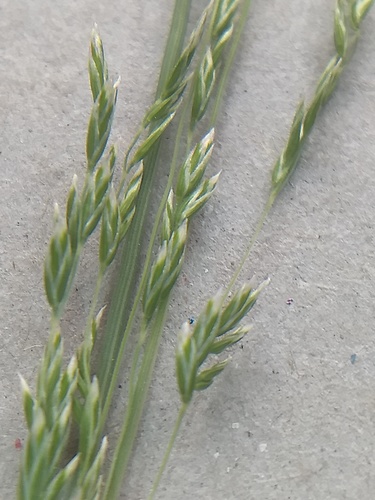
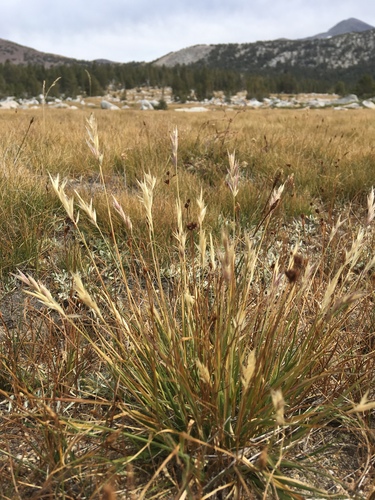
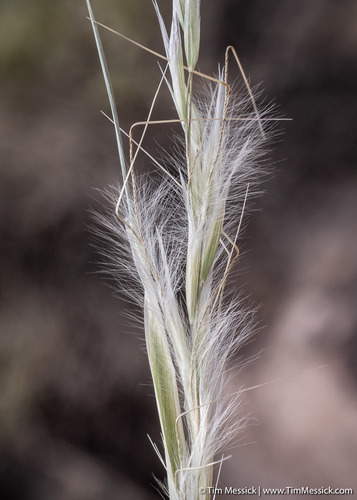
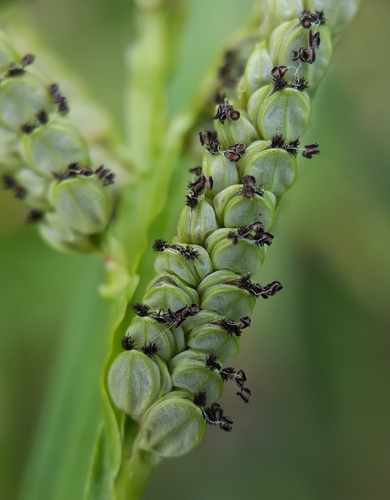
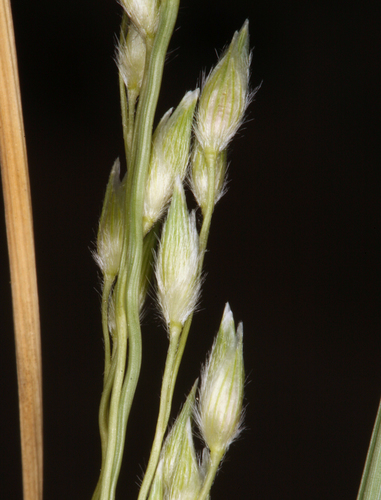
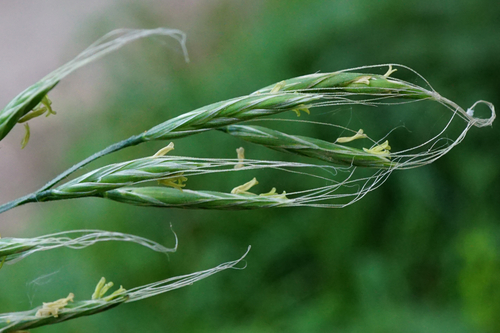
Giant fescue, scientifically named Lolium giganteum (L.) Darbysh., is a loosely tufted perennial grass. It produces erect to spreading hollow flowering stems that reach up to around 1.4 m (4 ft) tall, and can exceptionally grow to 165 cm. The stems have purple nodes, and are entirely glabrous (hairless), including their leaf sheaths. At the top of each leaf sheath is a short 2 mm ligule and pointed auricles that can wrap around the stem. Leaf blades are flat, up to approximately 15 mm wide, and glabrous. Non-flowering stems, called tillers, are typically shorter than flowering culms but otherwise match them in structure. Flowering normally happens in late summer, from mid-July to early September. The inflorescence is a loose, nodding open panicle that grows up to about 40 cm (18 inches) long. Panicle branches usually grow in pairs, with long stalks located below the spikelets; there can be up to around 16 spikelets per panicle branch. Each spikelet measures 10-17 mm long, and holds between 4 and 8 bisexual florets, plus two short, unequal glumes. The lower glume typically has only 1 nerve, while the upper glume has 3. Lemmas have long awns that reach up to 22 mm, which grow from the back of the lemma just below its tip. Each floret has 3 stamens, with anthers around 3 mm long. The fruit is a caryopsis (nut-like grain), with the seed tightly enclosed by the hardened lemma and palea. This species is common in its habitat, where it grows especially on heavy, neutral and calcareous soils, in woodland, hedge banks and shady places. It is reported to grow best in moist woods.