About Lolium arundinaceum (Schreb.) Darbysh.
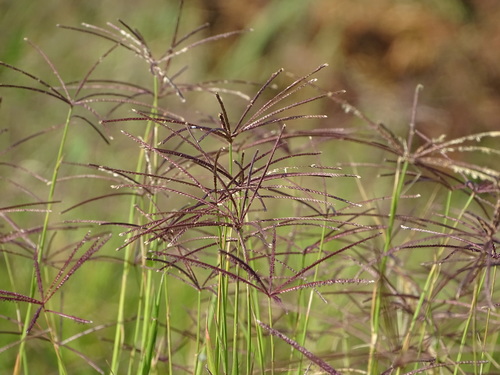
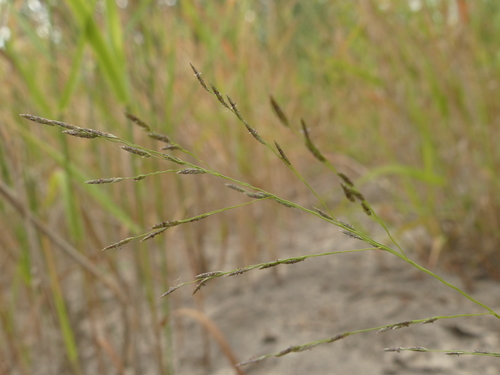
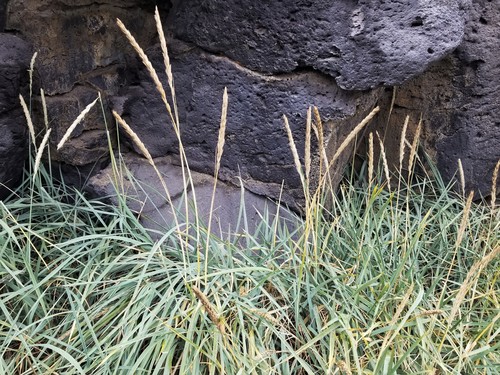
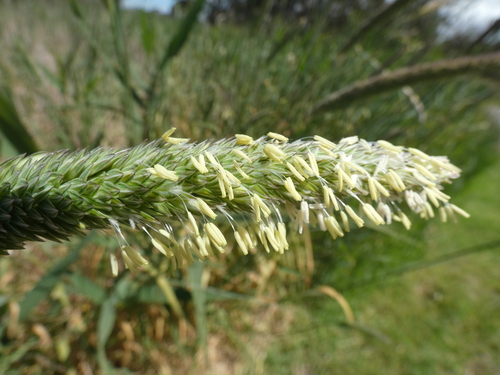
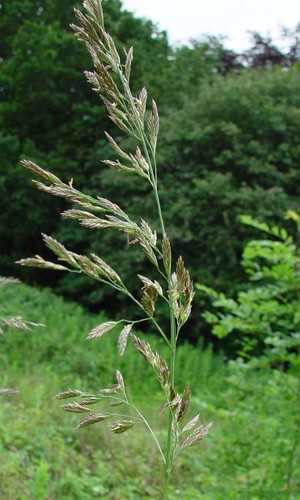
Tall fescue, with the scientific name Lolium arundinaceum (Schreb.) Darbysh., is a long-lived, tuft-forming perennial grass. It produces erect to spreading hollow, hairless (glabrous) flowering stems that reach up to around 165 cm (5 ft 5 in) in height, and may exceptionally grow to 200 cm. Both the stems and their leaf sheaths are glabrous. The grass has a 1.5 mm short ligule, and slightly hairy (ciliate), pointed auricles that can wrap slightly around the stem. Leaf blades are flat, up to around 10 mm wide, also glabrous, but rough on both surfaces and their margins. Non-flowering stems (tillers) are typically shorter than flowering culms but are otherwise similar in structure. Leaves have prominent parallel veins that run the full length of the blade. Emerging leaves are rolled within the bud (convolute vernation); most grasses have folded rather than rolled emerging leaves, so this is a key identification feature for tall fescue. Flowering usually occurs from early June to late August, and produces an erect to slightly nodding open panicle up to around 40 cm (1 ft 4 in) long. Panicle branches are normally borne in pairs, each holding 3 to 18 spikelets. Spikelets measure 9–15 mm long, and contain 4 to 8 bisexual florets, plus two short, unequal glumes. The lower glume has only 1 nerve, while the upper glume has 3. Lemmas typically have a short 3 mm awn growing just below the tip. Each floret has 3 stamens, with anthers around 3–4 mm long. The fruit is a caryopsis (nut-like seed) tightly enclosed by the hardened lemma and palea. In its native European range, tall fescue grows in damp grasslands, river banks, and coastal areas. The British National Vegetation Classification lists it as a minor component of many grassland types, but it is particularly characteristic of the MG12 Festuca arundinacea community: a tussock pasture type found in brackish grazing marshes along Britain's south and west coasts. This vegetation community is also host to uncommon plants including parsley water-dropwort and slender spike-rush. Tall fescue also grows in a number of salt marsh and maritime cliff communities in Europe. It is native to Europe, but has become established in introduced regions including North America and New Zealand. In New Zealand, it is especially prolific and often dominant in salt marshes. In North America, it thrives in grasslands, wetlands, riparian corridors, and marshy landscapes. In California, the cultivated form has become common in California grasslands and habitats such as the California coastal prairie plant community, and has been a topic of debate since its introduction. Its Ellenberg values in Britain are L = 8, F = 6, R = 7, N = 6, and S = 1, which indicate it favors damp, brightly sunny locations with neutral soils and moderate fertility, and can grow in slightly brackish conditions. Tall fescue was introduced to the United States in the late 19th century, but did not become a widely used perennial forage grass until the 1940s. Like in Europe, it has become an important, well-adapted cool-season forage grass for agriculture in the US, with many developed cultivars. Beyond forage, it is also an important grass for turf and soil conservation. It is the most heat-tolerant of the major cool-season grasses, and has a deeper root system than other cool-season grasses. This non-native grass is well adapted to the "transition zone" of the Mid-Atlantic and Southeastern United States, and now occupies over 35,000,000 acres (140,000 km²). Thanks to its robust root network and adaptability to different environments, it is sometimes planted to stabilize soil. The dominant cultivar grown in the United States is Kentucky 31. In 1931, E. N. Fergus, an agronomy professor at the University of Kentucky, collected seed from a tall fescue population growing on a hillside in Menifee County, Kentucky, though formal release of the cultivar did not occur until 1943. Fergus heard of this "wonder grass" while judging a sorghum syrup competition in a nearby town; he went to see the grass because it was green, lush, and growing well on a sloped hillside during a drought. He was impressed by the grass, collected seed samples, conducted variety trials, started seed increase nurseries, and praised its performance. Released as Kentucky 31 in 1943, it today dominates grasslands in the humid southeastern US. In 1943, Fergus and his colleagues already recognized the cultivar as vigorous, widely adaptable, capable of growing in poor soil conditions, and resistant to pests and drought. It is primarily used for pastures and low-maintenance sites. Plant breeders have developed numerous cultivars that produce dark green foliage and have narrower blades than the light green, coarse-bladed Kentucky 31. Tall fescue is the grass grown on the South Lawn of the White House. The predominant cultivar used in British pastures is S170.