About Lochmias nematura (Lichtenstein, 1823)
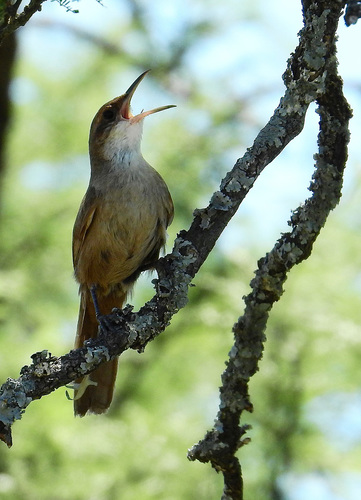
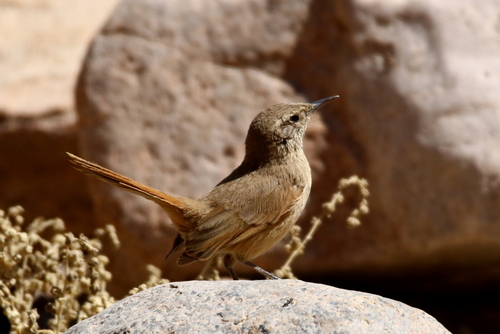
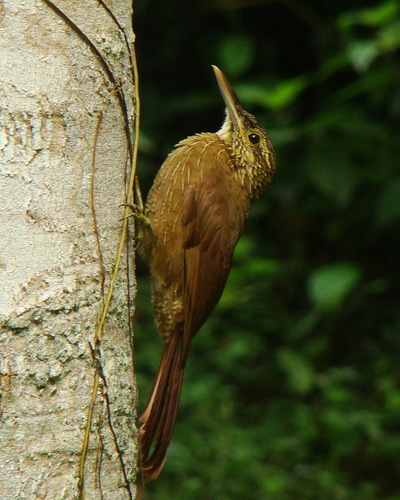
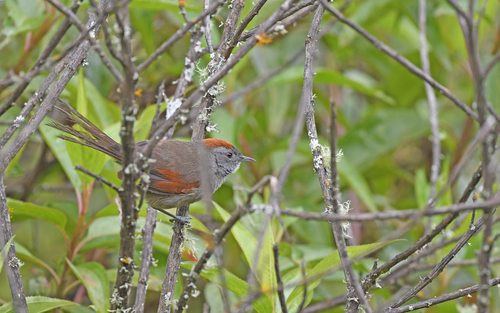
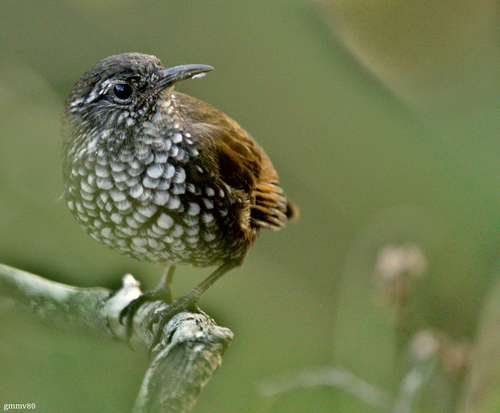
The sharp-tailed streamcreeper, scientific name Lochmias nematura (Lichtenstein, 1823), measures 13 to 14 cm (5.1 to 5.5 in) long and weighs 20 to 38 g (0.71 to 1.3 oz). It is a rather dark furnariid with a long, slightly decurved bill, and males and females have identical plumage. Adults of the nominate subspecies have a narrow, ragged white supercilium, blackish lores, dull brownish ear coverts with rufescent shafts, and a whitish malar area. Their crown is dark brown with faint spots on the forehead, their back is rich reddish brown that blends into a blackish rump and uppertail coverts. Their tail is sooty blackish with a "spiny" appearance, because the feather tips have bare shafts. Their wings are a similar reddish brown to the back. Their chin is whitish, their throat feathers are whitish with dark brown tips, their breast is dull dark brown heavily spotted with white, and their belly shares the breast's color but has white streaks. Their undertail coverts are blackish brown with pale shafts. Their iris is dark brown to brown, their maxilla is black to brownish, their mandible is black to grayish horn, and their legs and feet are highly variable, ranging from dull pink to dark brown. Juveniles are similar to adults, but their underpart spots are less well defined and somewhat buffy. Other subspecies of the sharp-tailed streamcreeper differ from the nominate subspecies and from each other as follows: L. n. obscuratus has little or no supercilium, a duller brown, less reddish back, darker throat and breast with oblong or diamond-shaped spots, and darker, unspotted belly and flanks. L. n. sororius has back and rump color that is more reddish than obscuratus but less reddish than the nominate, and its underpart pattern is also intermediate between the two. L. n. nelsoni has darker, less rufescent upperparts and more grayish underparts with less spotting than the nominate. L. n. chimantae is very similar to the nominate, with a darker, more brownish back. L. n. castanonotus has chestnut-brown upperparts, and less spotting and streaking on the underparts than the nominate. The sharp-tailed streamcreeper has several widely separated ranges, with subspecies distributed as follows: L. n. nelsoni is found on individual mountains in far eastern Panama's Darién Province. L. n. chimantae is found in the tepui region of Venezuela's Amazonas and Bolívar states. L. n. castanonotus is found in southeastern Venezuela and adjoining western Guyana. L. n. sororius is found in the Venezuelan Coastal Range, and all three Andean branches in Colombia, extending south through the Andes in Ecuador into Peru as far as the Department of San Martín. L. n. obscuratus is found in the Andes from Peru's Department of Huánuco south through Bolivia into northwestern Argentina's Jujuy and Salta provinces. L. n. nematura (the nominate) is found in Brazil from Mato Grosso to Bahia, and south through eastern Paraguay into northeastern Argentina to Entre Ríos Province and most of Uruguay. The sharp-tailed streamcreeper was first sighted in Guyana in 2002, and a specimen was collected there in 2004. It is not definitively known which Venezuelan subspecies the Guyanese records belong to, though they are currently attributed to L. n. castanonotus. The sharp-tailed streamcreeper is always found near streams and small rivers with dense undergrowth. In the mountains of Panama and Venezuela, and south through the Andes, it inhabits montane evergreen forest at elevations between 700 and 2,800 m (2,300 and 9,200 ft). In its southeastern range, it inhabits lowland evergreen forest and mature secondary forest.