About Lobostemon fruticosus (L.) H.Buek
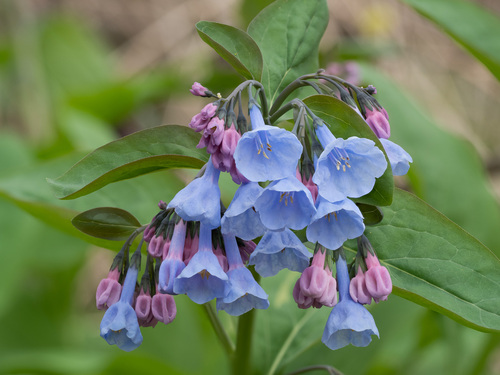
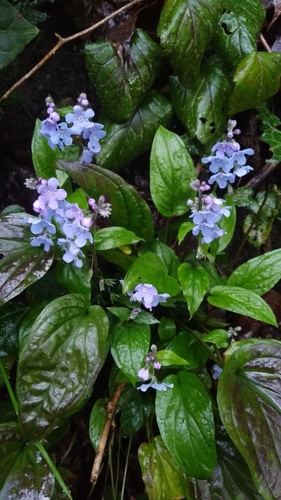
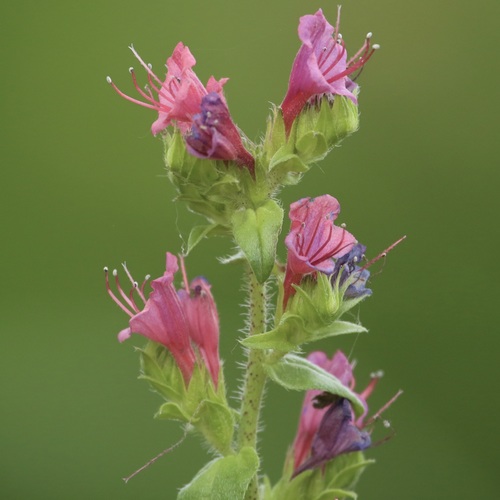
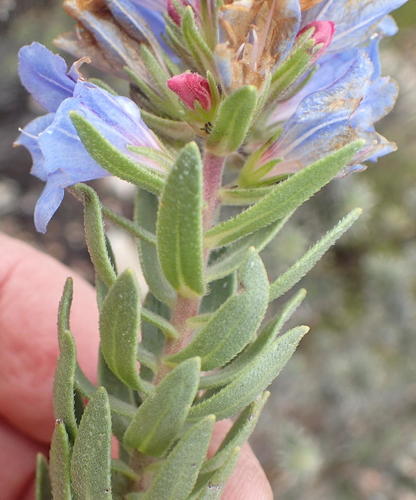
This shrub, Lobostemon fruticosus, grows 50 to 80 cm (20 to 31 in) tall, with many long branches emerging from its base. Lower stems are woody, while younger branches near the tips are soft and red in color. Its stalkless leaves are narrow, oval-shaped, and end in pointed tips; both soft herbaceous stems and leaves are covered in white hairs. Flowers bloom between May and December. These bell-shaped flowers range in color from pink to blue, and are borne in compound cymes. While flower color is variable, the inside and back of the flower are typically pink, fading to blue at the tips. The young flowering axis is compact, with flower buds loosely arranged to form a round (globose) unit, and spreads slightly during the fruiting stage. Stamens are unequal in length and typically do not extend past the rest of the flower. Staminal scales are ridge-like, lack lateral lobes, and are inserted well below the throat of the corolla tube, 2.5 to 3.5 mm (0.098 to 0.138 in) above the base of the corolla tube. This species produces four small nutlet seeds with spiny tips. It is easily confused with Lobostemon curvifolius, but differs in several key features: Lobostemon fruticosus has both long and short hairs (compared to the uniform hairs of L. curvifolius), smaller flowers measuring 18 to 23 mm (0.71 to 0.91 in) versus 25 to 28 mm (0.98 to 1.10 in) for L. curvifolius, and slightly differently shaped leaves. This species is mostly restricted to the west of the Cape Fold Mountains, occurring between Namaqualand and the Cape Peninsula, with additional populations found near Worcester. It grows on sandstone slopes, sandy flats, or shale flats. It is common in Renosterveld due to its preference for shale-derived soils, but agricultural activity has largely limited this species to growing along road verges. Lobostemon fruticosus, commonly called the eightday healthbush, often grows in large groups of individuals. It is frequently pollinated by bees. Its seeds are often poor quality, leading to low germination rates. Like other species in the Lobostemon genus, it is a resprouter and can regrow after a fire. This species holds importance in traditional medicine, used by the KhoiKhoi, European settlers, and Malay people to treat a range of conditions. It was mainly used to treat external wounds (including burns and ulcers) and skin conditions. It was also commonly used to treat blood poisoning, and occasionally used to treat stomachaches. A tea made from its leaves was used as a cure for ringworm in both humans and other animals. Leaves were applied as a multi-purpose plaster; for use, they would be chewed or pounded into a paste before being applied to injuries. Studies have confirmed that the leaves of this species have antibacterial properties, and are effective against several pathogens including Bacillus subtilis, Staphylococcus aureus, Escherichia coli, Klebsiella pneumoniae, Pseudomonas aeruginosa, and Salmonella typhi. Leaves and twigs also have anti-inflammatory properties: 13 compounds have been isolated from the plant, all of which show significant anti-inflammatory activity. The concentration of these compounds varies by region, and is highest in the Western Cape. Research has also found that this species has anti-cancer properties, and can induce apoptosis in lung cancer cells; it produces similar effects in pancreatic cancer cells. It was often used blended with other plant species to make medicinal preparations. For example, fresh leaves and branch tips were combined with Psoralea decumbens and Hermannia hyssopifolia to create an ointment for erysipelas. Leaves and flowers were fried in butter with leaves of Melianthus major and Melianthus comosus, plus bulbs of Cyanella lutea, to make a wound ointment. It was also mixed with Melianthus comosus and Galenia africana to create a watery lotion used to treat syphilis. Although wild populations of this species appear to be declining, it is a popular garden plant. It is the only Lobostemon species that is widely popular in cultivation, as other species are difficult and unpredictable to grow. While it can be grown from seed, seeds are usually hard to obtain. Propagation is most successful with cuttings taken from resprouting, non-flowering stems in spring or autumn, though success depends on the planting substrate. Cuttings planted in peat perform best in autumn, while cuttings planted in a sand-polystyrene mix perform best in spring. Applying plant growth regulators further increases the chance of successful propagation. Even though many cultivated plants are available, wild-harvested plants still supply most of the traditional medicine market.