About Lobostemon echioides Lehm.
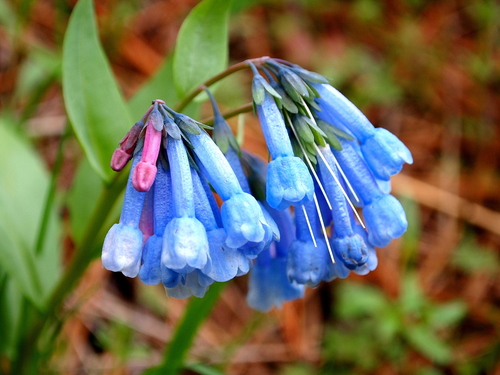
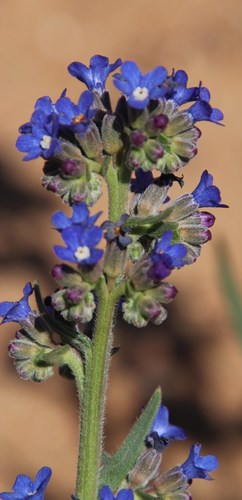
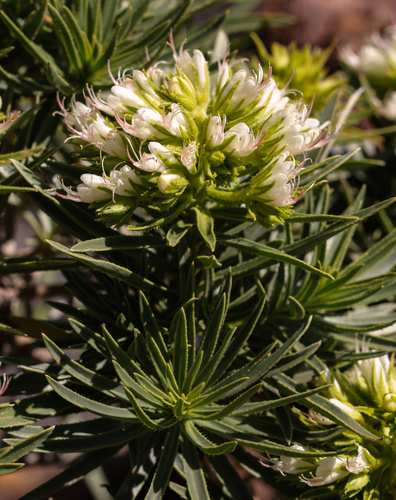
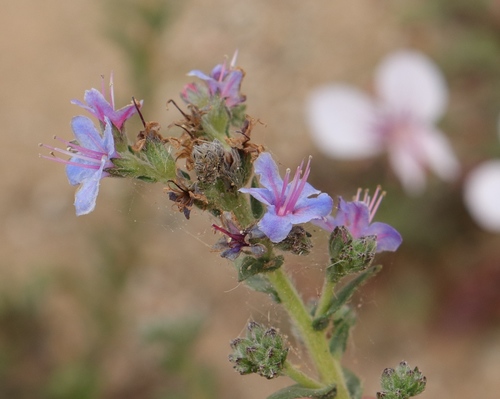
This species is a resprouting shrub or undershrub that reaches 20–80 cm (7.9–31.5 in) in height. Its stalkless leaves are narrow, hairy, and often soft and silvery. Flowering occurs mainly from August to October, though flowers can be found on this plant year round. Plants that flower from February to May appear to be limited to the southern parts of this species' distribution, where small amounts of rain are available throughout the year. The small flowers have violet-blue petals 17–30 mm (0.67–1.18 in) long. They are hairy on the outside, and are borne in cymes with many flowers. The buds are arranged in two distinct rows, and spread greatly when the plant enters the fruiting stage. The stamens protrude beyond the petals. The staminal scales are triangular with lateral lobes, and are inserted at the throat of the corolla tube, around 2–3 mm (0.079–0.118 in) above the base of the corolla tube. Lobostemon echioides is the most widely distributed species in the Lobostemon genus, occurring across the full range of the genus. It grows from Namaqualand and the Karoo through to the Eastern Cape. It prefers drier habitats, and is not found in wetter areas. It grows on stony slopes and flats, most often in soils derived from sandstone. Like other species in the Lobostemon genus, this species, commonly called common healthbush, can resprout after a fire.