About Lobodon carcinophaga (Hombron & Jacquinot, 1842)
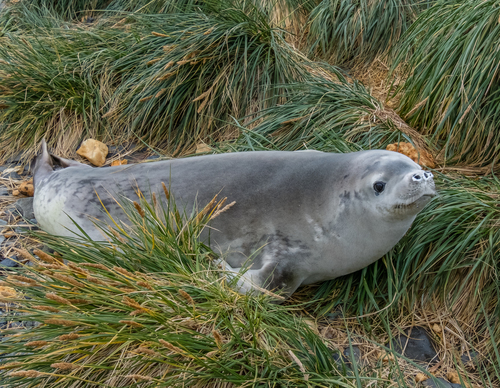
Description: For adult crabeater seals (over five years old), the average length is 2.3 m (7.5 ft) and the average weight is around 200 kg (440 lb). On average, females are 6 cm (2.4 in) longer and around 8 kilograms (18 lb) heavier than males. Weights of both sexes fluctuate substantially by season: females can lose up to 50% of their body weight during lactation, while males lose a significant proportion of weight when attending to mating partners and fighting off rivals. During summer, males typically weigh 200 kilograms (440 lb) and females typically weigh 215 kilograms (474 lb). The maximum recorded weight for large crabeater seals is up to 300 kg (660 lb). A molecular genetic technique has been developed to confirm the sex of individual crabeater seals in laboratory settings. At birth, pups measure about 1.2 metres (3.9 ft) in length and weigh between 20 to 30 kilograms (44 to 66 lb). While nursing, pups grow at a rate of approximately 4.2 kilograms (9.3 lb) per day. They reach around 100 kilograms (220 lb) when weaned at two or three weeks old. Most of the body of adult crabeater seals is covered in brown or silver fur, with darker coloration around the flippers. Fur color fades over the course of the year; recently molted seals are darker than silvery-white crabeater seals that are near their next molt. Their bodies are comparatively more slender than other seals, and they have pointed snouts. When on ice, crabeater seals can raise their heads and arch their backs, and they can move quickly if they do not become overheated. Crabeater seals regularly display scarring: scarring around the flippers typically comes from leopard seal attacks, while scarring around the throat and jaw in males typically occurs during fights for mates in the breeding season. Pups are born with a light brown, downy pelage called lanugo, which they keep until their first molt at weaning. Younger seals have net-like chocolate brown markings and flecks on the shoulders, sides, and flanks, which shade into the predominantly dark hind flippers, fore flippers, and head. Darkening in these areas is often caused by scarring from leopard seals. After molting, fur is darker brown, fading to blonde on the belly. Fur lightens over the year, becoming completely blonde in summer. Compared to other phocids (true seals), crabeater seals have relatively slender bodies, longer skulls, and longer snouts. Their most distinctive adaptation is unique dentition that allows the species to sieve Antarctic krill. Postcanine teeth are finely divided with multiple cusps. Combined with the tight fit of the upper and lower jaw, a bony protuberance near the back of the mouth forms an almost perfect sieve that traps krill inside. Distribution and population: Crabeater seals have a continuous circumpolar distribution surrounding Antarctica. Only occasional sightings or strandings occur on the extreme southern coasts of Argentina, South Africa, Australia, and New Zealand. They spend the full year on the pack ice zone as it advances and retreats with the seasons, and primarily stay within the continental shelf area in waters less than 600 m (2,000 ft) deep. They colonized Antarctica during the late Miocene or early Pliocene, 15–25 million years ago, when the region was much warmer than it is today. The entire crabeater seal population is connected and fairly well mixed, a state called panmictic. Genetic evidence does not support any separation into subspecies. A genetic survey found no evidence of a recent, sustained genetic bottleneck in this species, which indicates that the population has not likely suffered a substantial, sustained decline in the recent past. No reliable estimates of the total global crabeater seal population exist at present. Past estimates were based on minimal opportunistic sightings and a large amount of speculation, ranging from 2 million to 50–75 million individuals. Genetic evidence suggests that crabeater seal population numbers likely increased during the Pleistocene. The most recent point estimate puts the total population at 7 million individuals, which makes up around 85 percent of all Antarctic seals. Even this 7 million estimate is considered likely to be an underestimate. An international project called the Antarctic Pack Ice Seal initiative is currently ongoing to evaluate systematically collected survey data and produce reliable abundance estimates for all Antarctic seal species, including the crabeater seal.