About Lobivia ferox Britton & Rose
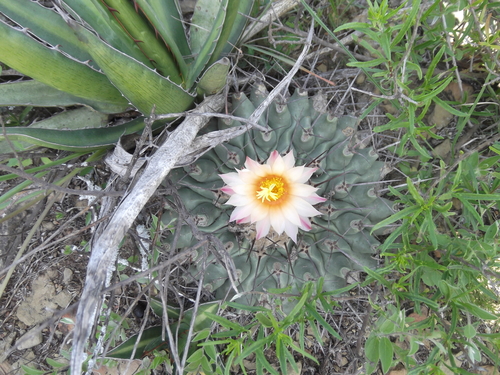
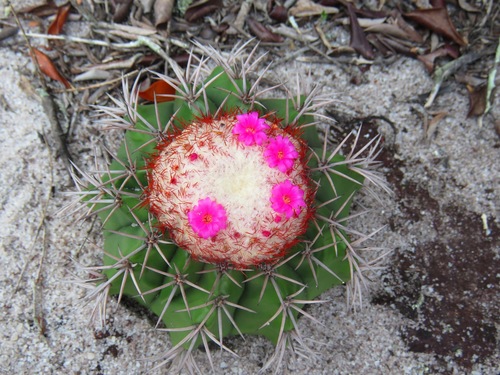
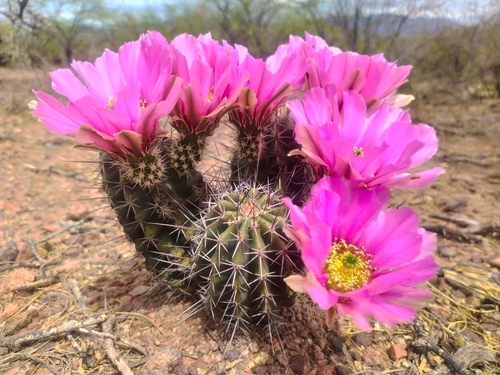
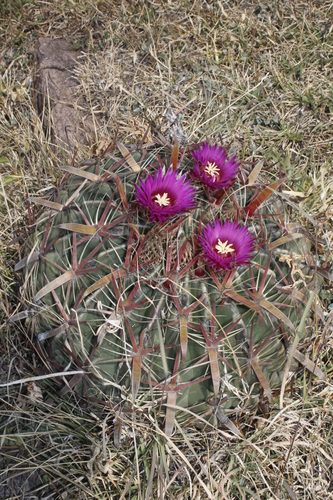
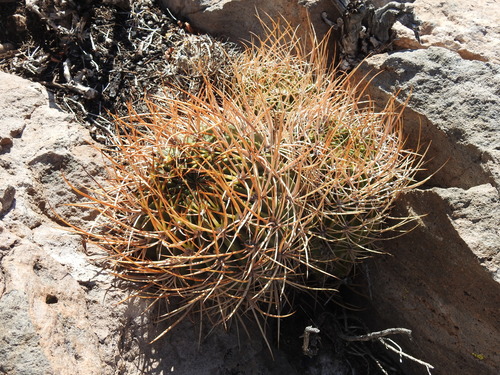
Echinopsis ferox (previously published as Lobivia ferox Britton & Rose) grows as a solitary plant, with a shape ranging from spherical to short cylindrical. It reaches 20 to 30 centimeters in height, and can grow up to 50 centimeters tall, with a diameter of over 30 centimeters. Around 30 spiral-shaped ribs are covered in sharp-edged humps. The oval areoles are spaced roughly 3 centimeters apart and covered in light wool felt. The thorns are long and stiff, ranging from curved to straight and sometimes hooked, and can almost completely cover the plant body. They are light brown to horn-colored, darker when new, and turn gray as they age. This cactus has 2 to 5 upward-curved central spines that can grow up to 18 centimeters long, and 8 to 14 3-7 cm long marginal spines that radiate outwards to the sides. The funnel-shaped flowers grow 9 to 11 centimeters long, and can reach up to 13 centimeters long, with a diameter of 6 to 8 centimeters that can reach up to 10 centimeters. They emerge laterally on the upper half of the shoot. Petal color ranges across white, pink, purple, yellow and orange. The yellowish stamens extend above the greenish flower centers. The greenish flower tube bears pointed scales; the axils of the scales are darker and covered in gray wool. The fruits are spherical to barrel-shaped, greenish, and split open when mature. The black-brown seeds are 1.5 millimeters long and 0.7 millimeters thick. Echinopsis ferox is widespread across Bolivia, where it occurs in the departments of Oruro, Potosí, Chuquisaca and Tarija; in Argentina, it grows in the provinces of Jujuy and Salta; and in Chile it is found in the province of Iquique. It grows at altitudes between 2000 and 3500 meters above sea level, reaching up to 4000 meters in Chile. Its large natural range produces a corresponding wide variety of forms.