About Lobelia urens L.
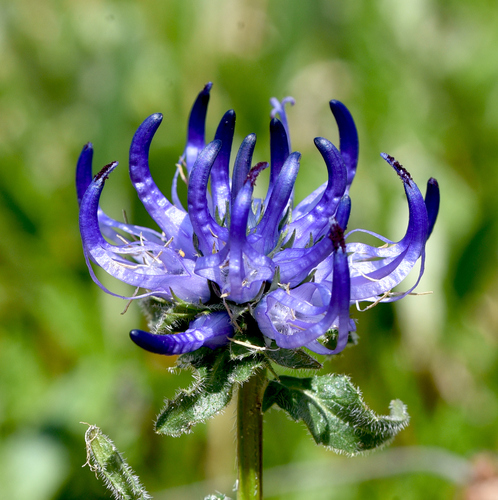
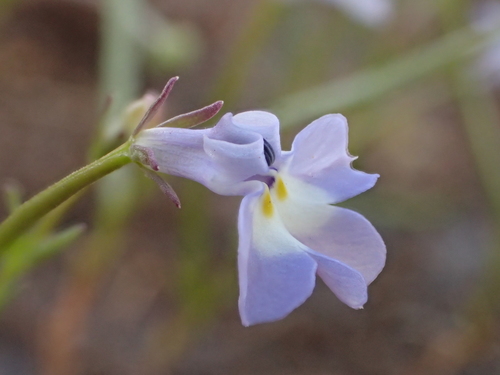
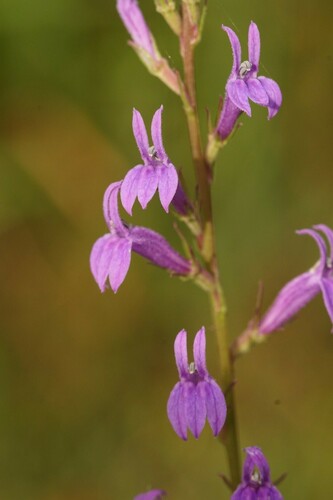
Lobelia urens L. is a roughly hairless perennial herb that grows to a maximum height of 60 cm, and it produces rhizomes. Basal leaves of this species are obovate in shape, while leaves positioned higher on the plant are linear to oblong. All leaves are shiny dark green, toothed, and attached with very short stalks. The calyx of Lobelia urens has long, very narrow teeth. Its flowers grow up to 1.5 cm long, and are blue-purple in color. The upper lip of each flower holds 2 narrow lobes, and the lower lip holds 3 narrow teeth. Flower stalks are less than 1 cm long, and corolla lobes are less than 2 mm wide. Flowering occurs from May through September, and the flowers are both hermaphrodite and zygomorphic. Seeds of this plant require patches of bare ground to germinate, and germination is better in soils with high moisture content. Seeds are produced year-round, with production peaking in July and August. Only seeds produced between March and June survive to grow into new plants. This species is distributed from north to south across southern England, where it is rare and restricted to lowland areas up to 210 metres in elevation. It is also found in Belgium, western lowland coastal France, humid western Iberian Peninsula, coastal plain Portugal extending into wet northern province valleys up to 800 metres, and western Spain, where it grows in grazed pasture of upland valleys between 600 and 915 metres in elevation. Additional native locations include the Rif Mountains of Morocco and the island of Madeira. It has been introduced to the Azores outside of its native range.