About Lobelia siphilitica L.
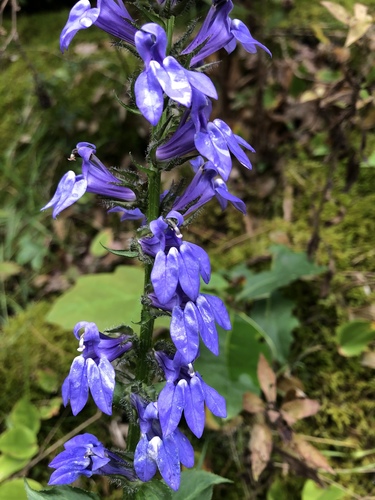
Lobelia siphilitica L., commonly called great lobelia, can grow up to 4 feet (1.2 m) tall. It has a single, ridged, unbranched stem that is either smooth or sparsely hairy. Its leaves are hairless or barely hairy, and range in shape from elliptical to lance-like, narrowing slightly at the base. They measure roughly 2 inches (51 mm) wide, and between 2 and 6 inches (51 to 152 mm) long. Leaves attach alternately to the stem, and have no leaf stalk. The plant has a central taproot root system that occasionally produces basal offshoots. In late summer, it produces a spike of zygomorphic flowers. Flowers are more tightly clustered near the top of the raceme, and become less dense further down; lower flowers begin blooming first. The flowers of great lobelia are noticeably larger than the flowers of many other lobelia species. Flowers are typically blue or violet, but can be lighter, even white, and are usually around 1 inch (25 mm) long. The tubed section of the flower is often striped. Great lobelia flowers have five petals: the three lower petals are fused, while the two upper petals are usually curled back. A curved style extends out between the two upper petals. The lower center lobe is wider, and has two small light-colored bumps near the flower throat. Seed pods of this species are two-chambered with an auriculate base, and hold many small seeds. Seeds are ovular, translucent, and golden brown; they are thought to be dispersed by wind or water. Great lobelia ranges from Maine to Manitoba in the north, and from North Carolina to Texas in the south. Sparse populations grow as far west as Wyoming and Colorado. It grows best in moist to wet soils and partially shaded habitats, including swamp forests, roadside ditches, floodplains, lake margins, and wet prairies. Lobelia siphilitica is sold at garden centers, and is commonly grown in USDA hardiness zones 4 to 9. It can be propagated by either cuttings or seed. Native Americans have a traditional practice of using Lobelia siphilitica to treat respiratory and muscle disorders. Early European settlers once believed it could cure syphilis, and this association gave the species its scientific name.