About Lobelia dortmanna L.
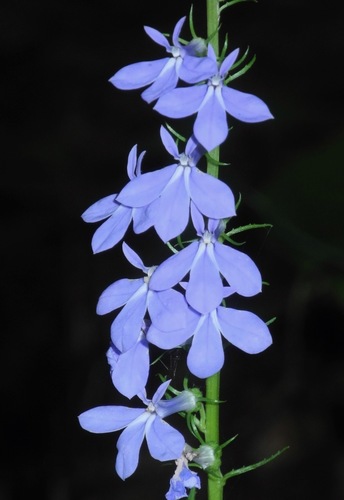
Lobelia dortmanna L., commonly called Dortmann's cardinalflower or water lobelia, is a species of flowering plant belonging to the bellflower family Campanulaceae. It is a stoloniferous, herbaceous perennial aquatic plant that forms basal leaf rosettes and produces flower stalks, reaching 0.7–2 m (2.3–6.6 ft) in height. Its flowers measure 1–2 cm long, with a five-lobed corolla that ranges in color from white to pale pink or pale blue. Flowers grow in groups of one to ten on an erect raceme held above the water surface. The fruit is a capsule 5–10 mm long and 3–5 mm wide that holds numerous small seeds. Its leaves are evergreen, almost cylindrical, blunt at the tip, and 2.5–7.5 cm long, and they lack functional stomata. Lobelia dortmanna is one of several unrelated low-nutrient lake plant species called isoetids, named for their superficial similarity to the genus Isoetes. Its leaves can be easily distinguished from those of other isoetids by having only two air-canals (Isoetes has four, and most other isoetids have several) and by producing milky sap. This species has the unusual trait of absorbing carbon dioxide from its rooting zone rather than from the atmosphere. Lobelia dortmanna, an endangered species, appears on the coat of arms of Ādaži Municipality in Latvia, which was adopted in 2021, and it grows in lakes within the municipality. This species is native to cool temperate regions of northern Europe, ranging from the British Isles and northwest France to northwest Russia, and northern North America, occurring along both coasts: from Newfoundland south to New Jersey and west to the Great Lakes in the east, and from British Columbia south to Oregon in the west. Its northernmost distribution reaches northern Norway, north of the Arctic circle. Ecologically, Lobelia dortmanna typically grows in shallow water on sandy, peaty, or rocky lakeshores, in pools, and in certain types of wetlands. It is rarely found in rivers. Low water periods can leave the plant temporarily exposed above the water, but it is sensitive to prolonged emersion, and is one of the first species lost when lake water levels are artificially managed. It has relatively low competitive ability, so it is usually restricted to areas with low plant cover, low sedimentation rates, and water depth less than 1 metre. It often grows alongside other isoetids including Littorella uniflora, Isoetes lacustris, Isoetes echinospora and Subularia aquatica. Lobelia dortmanna is recognized as an indicator of infertile, relatively pristine shoreline wetlands. It is put at risk by eutrophication, and it is used as an indicator species for relatively clear water and the possible presence of other less obvious isoetid species. Lakes that host this habitat are often called Lobelian lakes, a specific habitat type. Scientifically, these aquatic environments are classified as habitat type 3130: "Oligotrophic to mesotrophic standing waters with vegetation of the Littorelletea uniflorae and/or of the Isoëto-Nanojuncetea". In Europe, Lobelian lakes are relatively common in more mountainous areas.