About Lobelia deckenii (Asch.) Hemsl.
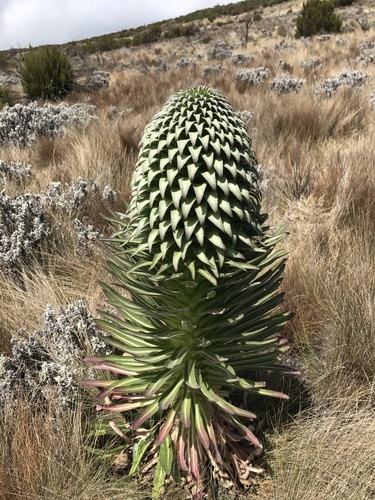
Lobelia deckenii (Asch.) Hemsl. is a species of flowering plant in the bellflower family Campanulaceae. It is a giant lobelia that is endemic to the mountains of Tanzania, and is listed as a threatened plant in the forests of Kenya’s Cherangani hills. It grows in moist habitats, including valley bottoms and moorland, which differs from the similar but drier habitat occupied by the related species Lobelia telekii. These two species occasionally form hybrids. Lobelia deckenii plants typically produce multiple connected rosettes that are linked underground, usually forming between one and eighteen rosettes per individual plant. Each rosette is made up of yucca-like leaves; when a rosette produces a large inflorescence, the entire structure can reach a maximum height of 3.7 meters (12 feet). Each rosette grows slowly in the alpine environment, and may take several decades to reach reproductive size. After growing for decades, a single rosette produces one large inflorescence that yields hundreds of thousands of seeds, then dies. This reproductive pattern for a single rosette is called monocarpy. Because whole individual plants have multiple rosettes, the entire plant survives to reproduce repeatedly, and plants that grow more rosettes flower more frequently. This makes Lobelia deckenii an iteroparous species. Lobelia deckenii is the only alpine lobelia species native to Mount Kilimanjaro, where it occurs at elevations between 3,800 and 4,300 meters (12,500 and 14,100 feet). Lobelia gregoriana, which was formerly classified as Lobelia deckenii subsp. keniensis, grows on Mount Kenya at elevations between 3,300 and 4,600 meters (10,800 and 15,100 feet). Lobelia deckenii is eaten less often by rock hyrax than Lobelia telekii, which more commonly grows in areas that are typical rock hyrax habitat. Both lobelia species found on Mount Kenya are pollinated by birds, particularly the scarlet-tufted sunbird and the alpine chat. Sunbirds of the family Nectariniidae are the main pollinators of Lobelia deckenii overall. This giant lobelia is well known for the water reservoirs held in its rosettes. This stored water freezes at night, and protects the apical meristem that is contained within the plant’s dense central leaf bud. If the reservoir is drained, the temperature of the inner meristem drops below freezing; this does not happen when the stored fluid is left intact. The crescent-shaped ice cubes that form in these rosettes gave the species the common nickname "gin and tonic lobelia".