About Lobelia angulata G.Forst.
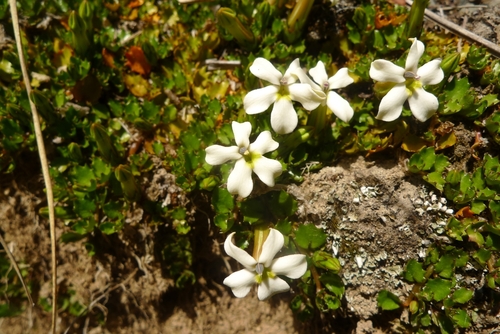
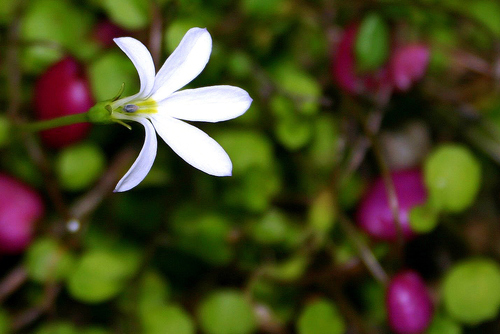
Lobelia angulata G.Forst. is a creeping, wide-spreading herbaceous plant that forms mats up to 1 metre across. It grows new roots at its leaf nodes. Its prostrate stems are green, with mottling that can be purplish, reddish, or greenish. Leaves are arranged alternately along stems, and are either sessile or borne on short petioles, with prominent blunt teeth along their edges. Leaf colour matches stem colour: leaves are green, or have purplish mottling or purplish edges. Most leaves are glabrous, but some have sparse, short, stiff hairs. Leaves are quite small, typically measuring 4–12mm long by 3–13mm wide. Flowers are prominent and eye-catching, with five (occasionally four or six) white petals arranged to give the flower a lopsided appearance. Flowers are borne on short, slender pedicels. The interior of the flower is yellowish, with a purplish tip on its reproductive column, and petals often have purple veins to varying degrees. Flowers are typically 7–20mm long, and have a short corolla tube that ranges in size, usually 7mm to 20mm long. Its prominent fruits are purplish-red when ripe, and are generally ovular or rounded, though they may sometimes be heart-shaped or flattened along one axis. Fruits are topped by calyx lobes, and contain thick-walled, foamy flesh. Hollow locules inside the fruit hold the plant's small seeds. Seeds are orange-brown, with a darker spot at both the apex and hilum, and are ovular or slightly oblong. The seed testa has a faint, widespread texture of ridges and pits, and seeds themselves are sticky and glabrous. Plants vary in size based on the altitude they grow at: individuals from higher altitudes are typically smaller than those from lower altitudes. Lobelia angulata is naturally endemic to New Zealand and some of its offshore islands. It has become an established exotic species in the British Isles, after first being brought there for cultivation in 1829, when it became established in and around the Royal Botanic Garden in Edinburgh. It is now quite widespread across the British Isles, especially in parts of England and Scotland, with sightings increasing since the turn of the 21st century. Within New Zealand, Lobelia angulata is widespread and common in damp habitats across most of the North Island, South Island, and Stewart Island. It is the most common and widespread native Lobelia species in New Zealand. It also grows on some nearby islands, including Ulva Island off Stewart Island, as well as the subantarctic Auckland Islands (specifically Enderby Island) and Campbell Island. Lobelia angulata grows in a range of moist habitats from lowland areas up to 1,300 metres above sea level in the low alpine zone. It is often found on stream banks, lake edges, forest edges, along tracks, in open forest, and other well-lit moist habitats. In alpine regions it grows in similar moist non-shaded habitats, including subalpine grasslands, herbfields, and closely grazed sites. It can tolerate temperatures as low as –10 degrees Celsius, but cannot thrive in overly dry environments. It grows in fully lit sites, as well as sites with partial or light shade. Lobelia angulata is a perennial fast-growing plant that lives longer than one year or growing season. It has a long flowering and fruiting season, and often bears both open flowers and ripe fruits at the same time. In its native New Zealand, flowering begins in late spring around October and continues until early autumn, typically March or April, with peak flowering occurring from November to March. Fruiting typically runs from late spring to early winter, with the highest fruiting activity in autumn during April and May, though fruits are consistently found through most of winter and spring. Seeds that have been excreted by weta are known to germinate faster than seeds extracted directly from fruit pulp. Because Lobelia angulata roots at leaf nodes, it can also spread to new areas via stem fragments that are washed or carried to new locations. In the British Isles, its flowering season is roughly reversed from its native New Zealand, with peak flowering occurring from July to September.