About Lobelia amoena Michx.
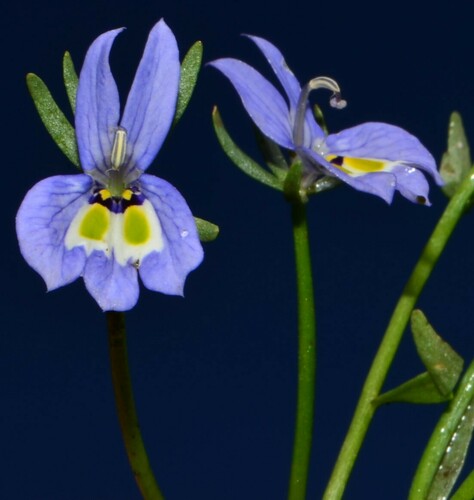
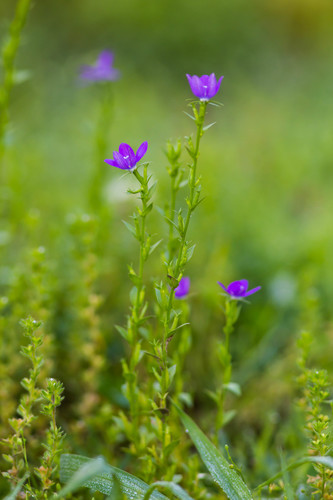
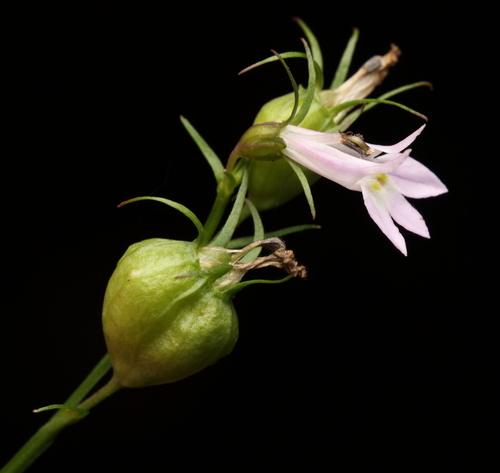
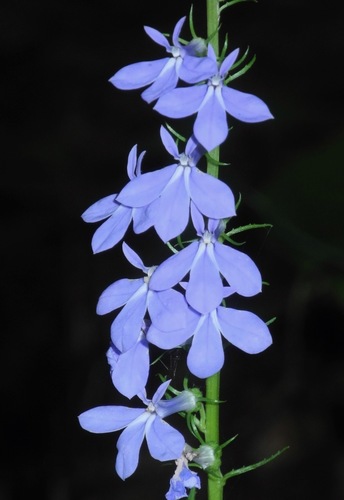
Lobelia amoena Michx., commonly called southern lobelia, can be an annual or perennial herb. It typically grows upright, with stems that are either strictly unbranched or freely branched. Its leaves range from elliptic to lanceolate in shape, 4 to 15 cm long and 2 to 4 cm wide, with margins that may be entire, crenate, or serrate. Its inflorescences are terminal racemes, which are often leafy and bracteate, making the flowers appear to be axillary. The flowers are zygomorphic and bilabiate, with a 5-lobed calyx that is more or less actinomorphic. The corolla is 2-lipped and fenestrate, with two lobes on the upper lip and three on the lower lip. Sepals have entire margins, or are remotely glandular-serrate. The corolla tube is 7 to 9 mm long, while the filament tube measures 5 to 7 mm. There are five stamens that are completely united. The fruit is a capsule 6 to 8 mm wide that dehisces through apical pores. Seeds are yellowish-brown, oblong, tuberculate, and 0.6 to 1 mm in length. Southern lobelia is distributed from western North Carolina and eastern Tennessee south through western South Carolina to central Georgia and eastern and central Alabama. A separate disjunct population occurs in the Florida Panhandle and along the coastal plain of Georgia and South Carolina. It grows in floodplain forests, seeps, marshes, and alongside streambanks.