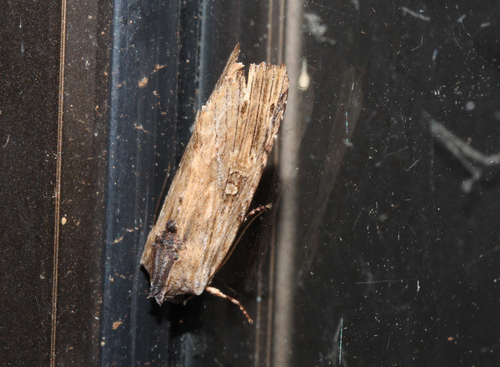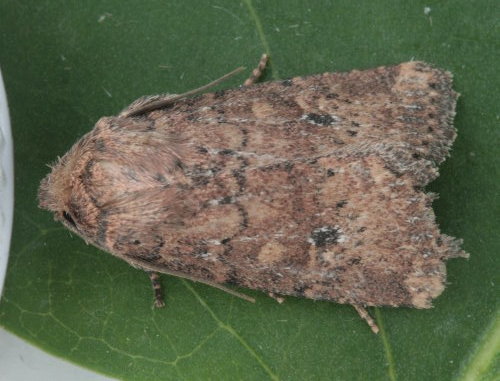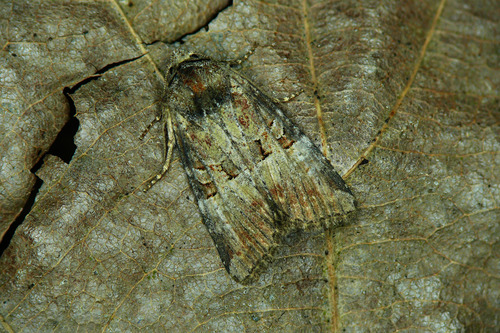
About Litoligia literosa (Haworth, 1809)
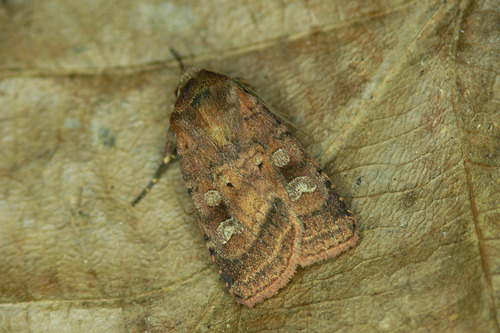
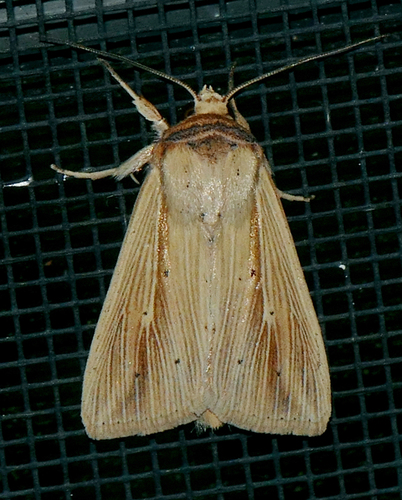
Technical description and variation: The wingspan of Litoligia literosa ranges from 23 to 30 mm. The forewing is violet grey, with a partial rosy-brown flush; the costa, cell, and median area are dark fuscous, and the costa often stays pale. The inner and outer lines are dark, conversely edged with pale; the inner line is strongly outcurved below the middle, and lies closely approximated to the erect lower half of the outer line. A black bar runs between the two lines along the submedian fold. The claviform stigma is either obsolete or minute. The orbicular stigma is grey, with only its edge margined in black; its margin is straight and forms nearly a straight line with the lower half of the outer line. The submarginal line is pale grey, the shade before it is red brown, and the terminal area is dark grey. The hindwing is greyish fuscous. In the aberration constricta ab. nov. [Warren], which is principally confined to males, the median area between the two lines is narrowed and much darker, especially in the two folds, and the red flush is less developed. The form subarcta Stgr. found in Sicily, Palestine, and western Siberia has longer wings and no red tints at all except the praesubmarginal shade; the author of this description feels sure this form will be proven to be a distinct species. On the other hand, the darker grey and fuscous tints may be reduced, and the whole forewing may become suffused with rosy brown, with the whole thorax also showing rufous; this is the aberration subrosea, a common form in England. The aberration onychina H.-Sch. shows an even greater reduction of dark tints, with the whole forewing being creamy grey; the usual darker median area and the shade before the submarginal line appear pale golden brownish in certain lights, and the hindwing is pale grey. This form occurs in Heligoland, Norderney, and other islands, with its colouration assimilated to the sandy coasts. Some forms of Litoligia literosa are very similar to Mesoligia furuncula, and certain identification requires study of the genitalia, but even this process is problematic.