About Lithotoma axillaris (Lindl.) E.B.Knox
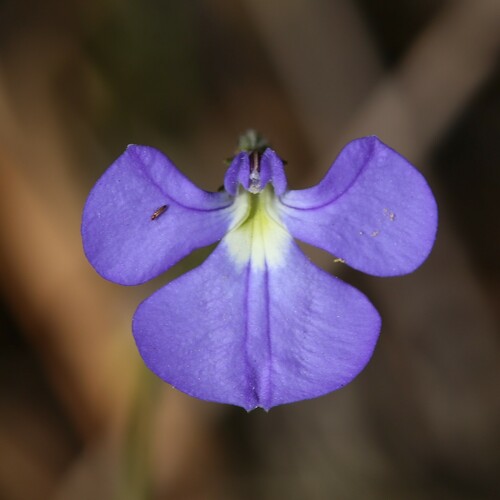
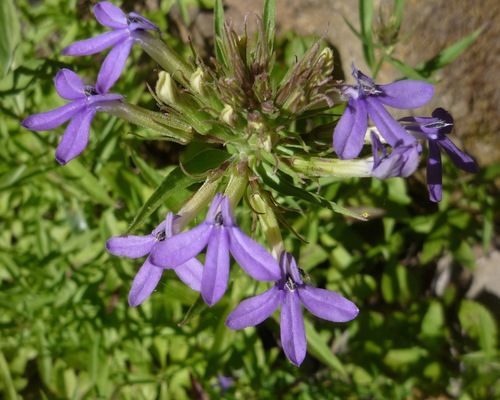
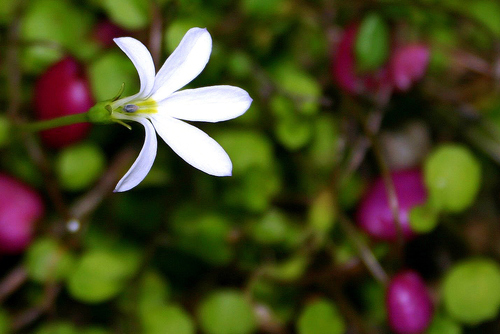
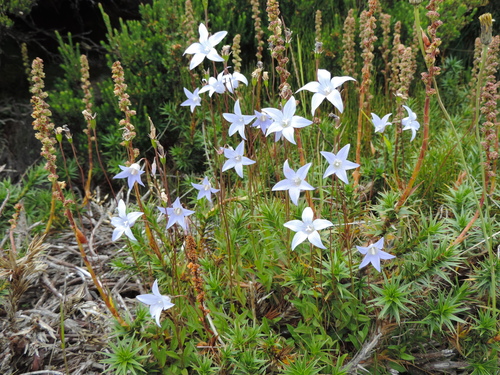
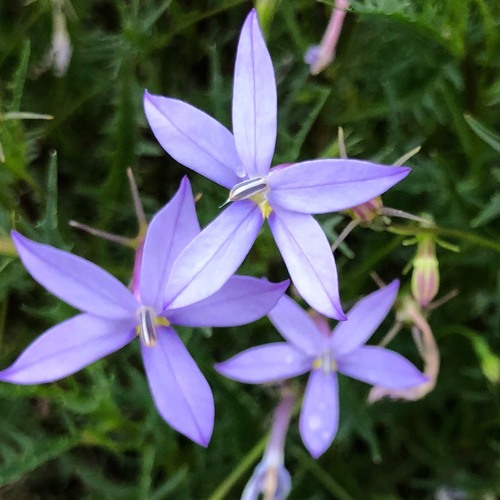
This species was previously described under the synonym Isotoma axillaris. It is an upright perennial herb that grows up to 50 cm in height, with ascending stems that are often purplish. The stems are initially covered in short, soft hairs, and quickly become smooth. Leaves are between 1.5–15 cm long and 0.5–5 mm wide, with deep toothed linear lobes ending in a sharply pointed apex. Single flowers grow from leaf axils; they are most commonly blue to mauve, and rarely white or pink. The throat of the flower may occasionally be white, greenish, or yellow. The five flower lobes attach to a flower tube that is 15–35 mm long, borne on a 3–17 cm long peduncle. The lobes are elliptic to oblong in shape, 8–18 mm long, and are not connected to one another, forming a star-shaped flower. The seed capsule is 7–8 mm long. In its native range, flowering occurs from September through May. In its native distribution, this species (commonly called showy isotoma) grows in Queensland, New South Wales, and Victoria, most often in moist crevices on rocky outcrops. It is cultivated as a garden plant. It is winter hardy to approximately −1 °C (30 °F), corresponding to USDA Zone 10. In colder climates, it can be grown as an annual, or overwintered indoors.