About Lithospermum ruderale Douglas ex Lehm.
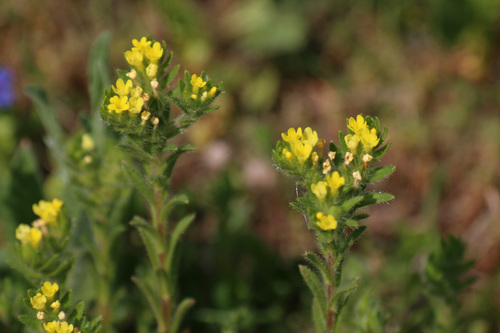
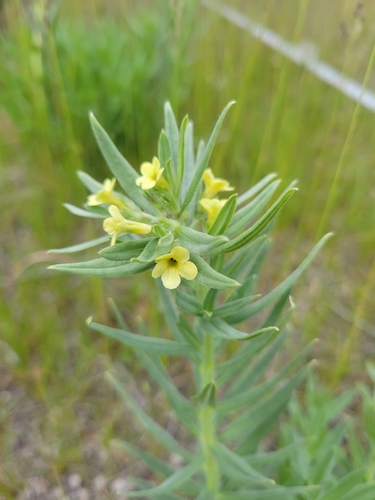
Lithospermum ruderale Douglas ex Lehm. is a perennial herb that grows from a taproot and woody caudex. The entire plant, particularly its stems, is covered in fine, more or less upright hairs. It forms a cluster of erect leafy stems that reach 20 to 60 centimetres (8 to 23+1⁄2 inches) in height. Stems bear lance-shaped leaves that measure 2.5 to 10 centimetres (1 to 4 inches) in length.
Flowering occurs from April to June. Clusters of flowers with leaf-like bracts develop near the top of stems, among existing leaves. The flower's corolla is fused at the base, with five light yellow lobes that are often slightly greenish. The corolla measures roughly 1 centimetre in both length and width. The throat of the flower is glandular and has no protrusions, and the style is short.
The fruit of Lithospermum ruderale is a cluster of one to two, sometimes four, glossy grey nutlets. Each nutlet can grow up to 6 millimetres (1⁄4 inch) long.
This species is native to western Canada and the western United States. It grows in open areas located near sagebrush, juniper, and pine.
Several Native American groups, including the Navajo and Shoshone, used this plant as a contraceptive. Studies on mice have found that the plant reduces fertility in test subjects. Plains Indians used the plant's roots to treat respiratory problems, and also cooked the roots to eat as food.