About Lithospermum officinale L.
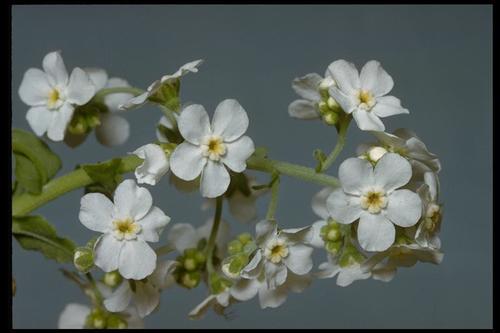
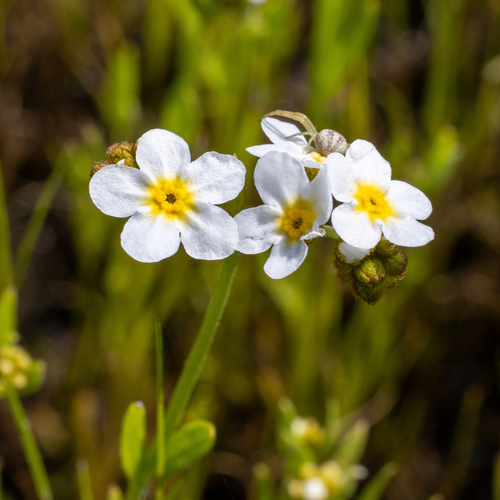
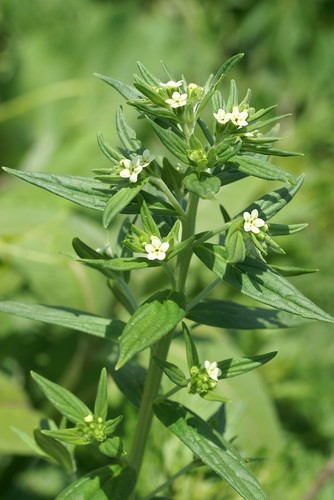
Common gromwell, scientifically named Lithospermum officinale L., is an erect, downy perennial plant that reaches 60 to 80 cm in height. Its unstalked, lanceolate leaves can grow up to 10 cm long, and have prominent lateral veins on their lower surface. Greenish white, funnel-shaped flowers bloom from June to July; each flower is 3 to 4 mm across, and grows in short, dense cymose clusters inside leaf axils. As the plant develops fruit, the inflorescences become elongated, V-shaped sprays. The fruit consists of 4 shiny white nutlets that are 3 to 4 mm long, and these nutlets remain on the plant well into winter. This species has a very wide distribution across Europe and Asia. In the UK, it is locally common, but is much rarer in the northern and western parts of the country. It prefers habitats including grassland, scrubland, and open woodland, and typically grows on base-rich, calcareous soils. All parts of Lithospermum officinale L. have a long history of traditional use as a natural medicinal remedy for a range of ailments. For example, in India, leaves were historically used as a sedative. Seeds have been used as a diuretic, lithotritic, febrifuge, anti-gout, anti-ovulary, and anti-toxic agent, as well as an anti-inflammatory for urinary tract diseases and to improve digestion. A herbal tea made from the root and stem, or a decoction of roots and twigs, was once prepared as a syrup to treat smallpox and measles; this tea also worked as an antipruritic. Archaeologists uncovered a plaster poultice containing L. officinale nutlets at a gravesite in Poland. Modern research has found the plant is a potent natural anti-inflammatory and effective for healing burn wounds when applied topically, which accounts for its inclusion in the found poultice. L. officinale also held important cosmetic and ornamental value historically. Its roots were once used to color fibers and make makeup dye. Approximately 2,500 year ago, intact, well-preserved L. officinale fruits were glued onto two wooden tubs recovered from the Yanghai Tombs in Xinjiang, China. These nutlets were likely used for decoration. Their lustrous, porcelain-like appearance and hardness made them popular and suitable for use as beads in Bulgaria and central Europe as early as the Neolithic period.